
How to follow up on wedding RSVPs
To follow up on wedding RSVPs that never came back, wait about a week after your deadline, then chase each missing guest by text or phone, twice at most, and count anyone still silent as a no. Plan it backwards from the day your caterer needs the final count, so the chasing is over before that date, not on it.
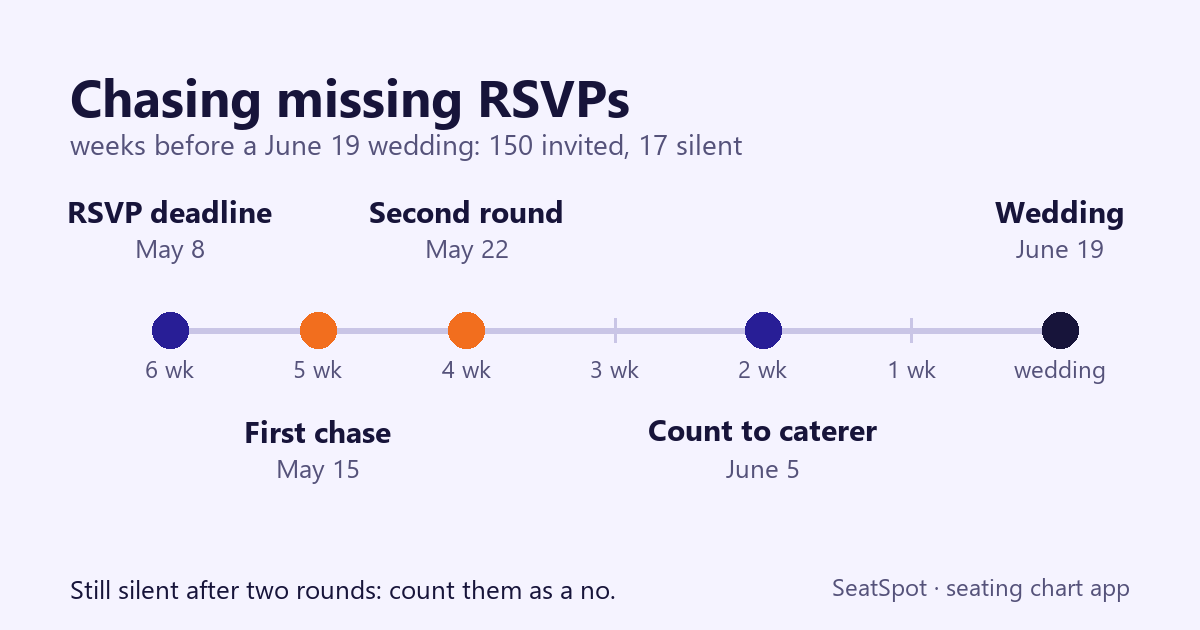
When should you follow up on wedding RSVPs?
About a week after the deadline, not on the day itself. Joy's reason is that some replies are still in transit, and Pleasantdale adds that some guests mail their card on the deadline itself. Calling the morning after the deadline makes you look anxious and catches people who already answered.
The fixed point is your caterer, not your invitation. Joy says vendors usually want final numbers one to two weeks before the wedding and suggests an RSVP deadline two to three weeks before that. Paperlust puts the deadline four to six weeks out and the caterer count about two weeks out (two to three in its timeline). Put together, that gives a plan you can date from the wedding backwards:
| What happens | Weeks before the wedding | Date for a Saturday, June 19, 2027 wedding |
|---|---|---|
| RSVP deadline | 6 | Saturday, May 8 |
| First follow-up round | 5 | Saturday, May 15 |
| Second round, if needed | 4 | Saturday, May 22 |
| Final count to the caterer | 2 to 3 | between May 29 and June 5 |
| Seating chart finished | 10 to 14 days | between June 5 and June 9 |
We counted the dates from the wedding day, so swap in yours and keep the gaps. If your caterer wants numbers earlier, Paperlust's advice is to shorten the follow-up window, not to push the caterer. The gaps matter more than the exact weeks: a week of grace after the deadline, a week between the two rounds, and at least a week between the last round and the caterer count.
For when to start the chart itself, see when to make your wedding seating chart.
Should you text, call or email?
Match the channel to the guest. The guides we read agree on a simple split:
- Text close friends and family. Joy recommends text for this group; Paperlust adds that you should call if a text gets no reply within 48 hours.
- Call older or more traditional guests, who may not check texts. Joy and Paperlust both suggest the phone here, and Pleasantdale prefers a call over email for everyone, because email can end up in spam.
- Email acquaintances and professional contacts, which is where Paperlust puts it.
Keep it short and friendly, and assume a lost card before you assume rudeness. Pleasantdale suggests using the call to collect what the card would have told you, such as a meal choice or a dietary need, and asking an undecided guest to confirm by a named day ("by Tuesday") rather than "within 48 hours", which sounds like a demand.
Who should make the follow-up calls?
The sources disagree, and the disagreement is useful. Paperlust suggests one caller per side of the family, ideally a parent or sibling, with the couple contacting only their closest friends. Pleasantdale says the couple should call, because a parent may not push for a firm answer and may give relatives extra time.
A workable middle: you call or text your own friends and anyone whose answer affects the seating plan, such as a family with children or a guest with a plus-one. A parent calls the relatives and family friends they invited, with a clear brief: the date you need an answer by, and that "maybe" is fine as long as they tell you when they will know.
Should you count no RSVP as a no?
Yes, once you have tried. Paperlust's rule is up to three attempts across at least two channels, then mark the guest as not attending and stop holding a seat. Joy also says to mark guests as not attending after several unanswered attempts, and suggests a few spare place settings at a seated dinner for the person who turns up anyway.
What about someone who replies late? Paperlust's view is that a reply within about a week of the deadline can usually be accepted if the caterer allows late additions, often for a fee, while a reply two or more weeks late can be politely declined.
A worked example: 150 invited, 17 silent
You invited 150 guests to a June 19 wedding. By the May 8 deadline, 112 have said yes, 21 have said no and 17 have not answered.
- May 15, first round. You text your friends and a parent calls the older relatives. Nine of the seventeen answer: six yes, three no. You now have 118 yes, 24 no and 8 silent.
- May 22, second round. You try the last eight again on a different channel. Nobody answers.
- Count them as a no. 118 yes + 24 no + 8 silent = 150, so nobody is missing from the count. The caterer gets 118, plus any spare settings you agree with them.
- Decide the buffer once. Paperlust suggests 5 to 10 percent above the confirmed count. On 118 guests that is up to 124 or 130 meals, which is a lot of food for a dinner where you have already chased everyone twice. Joy's "a few extra place settings" is the more modest end; ask your caterer what they charge for each.
Our post on how many invited guests will say yes has benchmark numbers for how many guests usually stay silent, if you want to estimate the size of your chase list before the invitations go out.
Doing this in SeatSpot
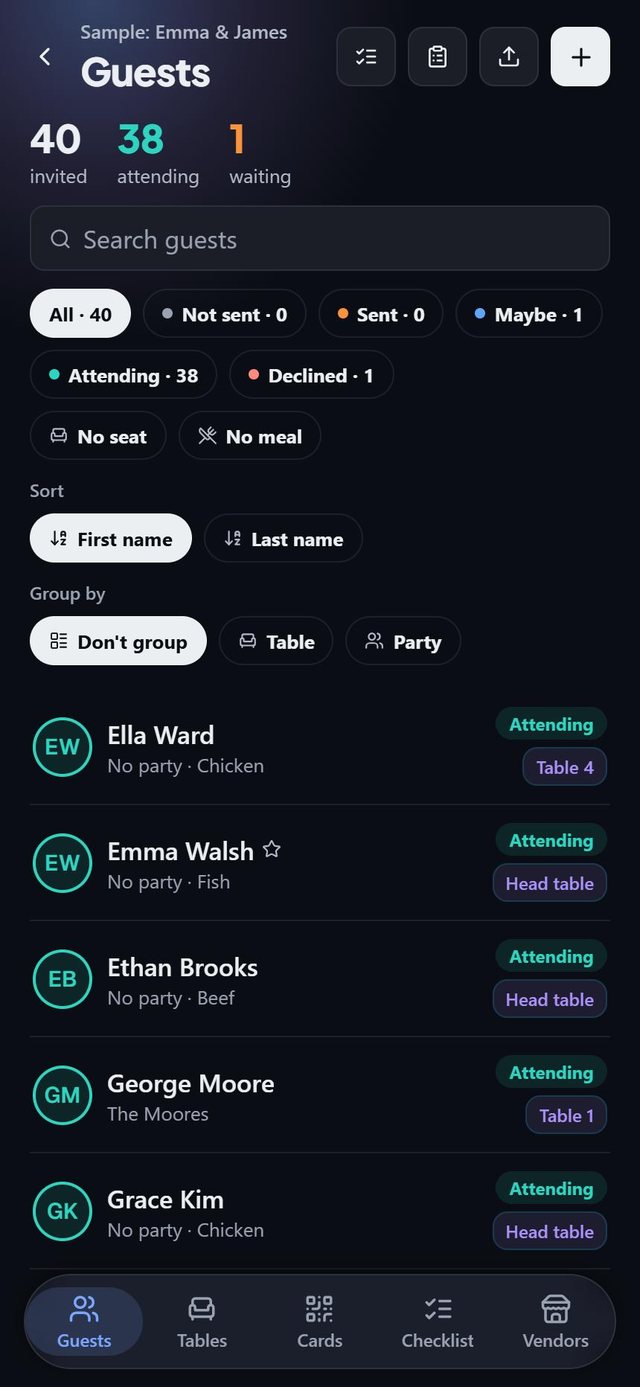
SeatSpot keeps the chase list for you, because it separates the guests you have not invited yet from the ones who owe you an answer.
- See who owes you an answer. On the Guests tab, filter the list by RSVP status and choose Sent: those are the people who have the invitation and have not replied. The waiting number at the top of the tab counts everyone without a yes or a no.
- Record answers as they come in. Mark guests Attending or Declined, one at a time or several together with selection. A guest who replies "we'll know next week" goes to Maybe: the plan still counts a place for them, but they are not in the meal counts, so you stop chasing them without inflating the caterer's numbers. See RSVP tracking.
- Close the list. After your second round, select the guests still on Sent and mark them Declined in one step. Declining releases any seat they held, so the tables show the real room.
- Let the app remind you. If your event has a date, SeatSpot sends a planning reminder 14 days before, such as "8 RSVPs still missing", when anyone has still not answered.
- Hand over the count. Meal counts only ever come from Attending, so the number you give the caterer is the number of confirmed guests.
SeatSpot is available on Google Play and the App Store.
Questions people ask
How long after the RSVP deadline should you wait before following up?
About a week. Replies still arrive in the mail after the deadline, and a week leaves enough time for two rounds of chasing before the caterer needs a number.
Is it rude to remind guests to RSVP?
No. A short, friendly message that explains why you need the answer, such as a caterer deadline, is normal. Assume the card was lost rather than ignored.
How many times should you contact a guest who hasn't RSVPed?
Two rounds is enough for most guests; Paperlust's limit is three attempts across at least two channels. After that, count them as not attending.
What if a guest who never replied shows up?
Have a few spare place settings, as Joy suggests, and a chair you can add to a table that has room. It happens rarely enough that paying for a full extra table is not worth it.
Created by Mariusz Bednarczyk and fact-checked against the sources above. He reads each post after publication. How we make posts: About the blog.
Plan it next
Related guides
- What % of wedding guests RSVP yes? About 72 per 100
- When does the caterer need a final headcount?
- Wedding B list: when to send second-round invites
Start here: How to make a wedding seating chart, step by step
More in Guest list and RSVPs