
Wedding B list: when to send second-round invites
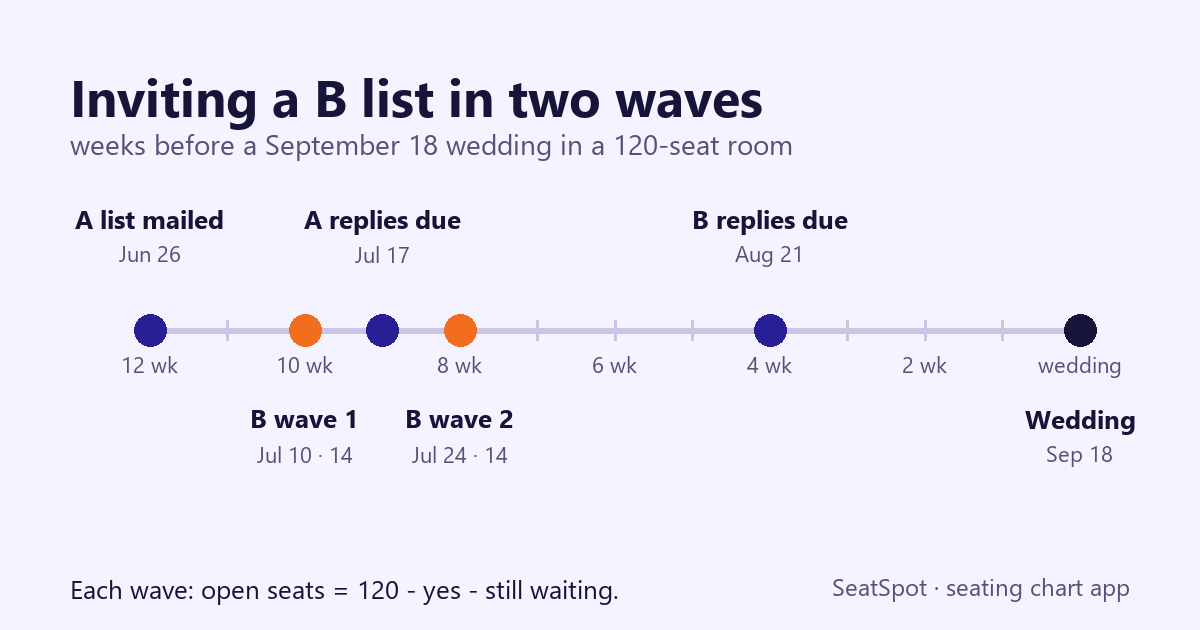
A wedding B list works if the first wave of invitations goes out early, about 12 weeks before the wedding, and the B list follows as declines arrive, ideally by the 8-week mark. The one rule that keeps it safe: never send more B-list invitations than you have open seats, counting every guest who has not answered yet as a yes.
What is a wedding B list?
Your A list is the people you cannot imagine the day without. Your B list is the people you would like to invite if there is room: often extended family, friends you rarely see and coworkers, as WedSites describes it. The A list is invited first; each decline frees a seat, and the next B-list name gets that seat.
Couples use one when the venue or the budget sets a hard limit and they expect a share of the A list to say no. If you are trying to guess how big that share will be, our post on how many invited guests will say yes has the benchmark numbers.
When to send B-list wedding invitations
Work back from the wedding. The guides we read agree on the order and differ a little on the weeks:
- A list: WedSites suggests about 12 weeks before the wedding; Philadelphia Magazine says at least eight.
- B list: WedSites says once A-list replies show how much room you have, ideally around eight weeks out, because later invitations can feel like a last-minute addition. Philadelphia Magazine says to send them as soon as you can, with a reply date no later than four weeks before the wedding.
- Two reply dates: Inside Weddings recommends an early reply date for the first batch and a later one for the second.
Here is that plan dated for a Saturday, September 18, 2027 wedding:
| Step | Weeks before the wedding | Date |
|---|---|---|
| A list mailed | 12 | Saturday, June 26 |
| First B wave, as declines come in | 10 | Saturday, July 10 |
| A-list reply date | 9 | Saturday, July 17 |
| Last B wave | 8 | Saturday, July 24 |
| B-list reply date | 4 | Saturday, August 21 |
We counted the dates from the wedding day, so swap in yours and keep the gaps. Two things matter more than the exact weeks. Do not wait for the A-list deadline before sending the first B wave; the first declines often come back well before the deadline, and every week you wait is a week less notice for the B guest. And stop at eight weeks: past that, a guest who compares envelopes with a friend can tell they were second.
How many B-list guests should you invite?
Never more than the seats you can prove are free. Philadelphia Magazine's rule is not to send more B-list invitations than you have open places, and to rank the B list in order so the next name is already decided when a decline arrives.
The safe way to count open seats is pessimistic: treat everyone who has not answered, from either list, as a yes.
Open seats = room capacity − guests who said yes − guests still waiting
This is what that looks like in a 120-seat room where all 120 A-list invitations went out on June 26:
| Date | Invited so far | Yes | No | Still waiting | Open seats | B invitations sent |
|---|---|---|---|---|---|---|
| July 10 | 120 | 58 | 14 | 48 | 14 | 14 |
| July 24 | 134 | 92 | 28 | 14 | 14 | 14 |
| August 21 | 148 | 113 | 35 | 0 | 7 | none, too late |
Each row adds up: yes, no and waiting always equal the invitations sent so far. Because the waiting guests are counted as a yes, the room can never be overbooked: if every guest still waiting says yes, you land on exactly 120.
The cost of that caution shows in the last row. By the B-list reply date, seven seats are free and it is too late to fill them politely. That is the honest trade-off of a B list: a few empty chairs or a few seats over capacity. We think empty chairs are the better mistake: a room over its capacity is a problem on the day, an empty chair is not.
When the replies are in, chase anyone still silent before your caterer deadline. Our post on how to follow up on wedding RSVPs has a dated plan.
Is a wedding B list rude?
It can be, which is why every guide we read spends more time on discretion than on dates. Inside Weddings calls the practice fairly controversial, and Philadelphia Magazine notes that planners often advise against it altogether. Done carefully, it mostly goes unnoticed:
- Invite whole groups in one wave. If half of your college friends get an invitation in June and the other half in July, they will compare. Inside Weddings suggests B-list groups that stand on their own, such as coworkers or a book club; WedSites also says not to split a close circle.
- Print a second set of reply cards. Inside Weddings warns against sending a B guest a card whose reply date has already passed, because it tells them they missed the first cut. WedSites notes that online replies avoid the problem.
- Have an honest answer ready. If someone asks why their invitation came later, WedSites suggests saying you were working within your venue capacity or budget. Inside Weddings adds that "it must have got lost in the mail" is believable for one or two people at most.
Do B-list guests get save-the-dates?
No. Philadelphia Magazine's advice is to send save-the-dates to the A list only, as early as possible. A save-the-date is a promise of an invitation, so sending one to a guest you may not invite causes the exact problem the B list is meant to avoid. The replies you get to save-the-dates are also an early hint of how many A-list guests will decline.
If you are still deciding who belongs on which list, our post on how to cut your wedding guest list walks through the cuts with numbers.
Doing this in SeatSpot
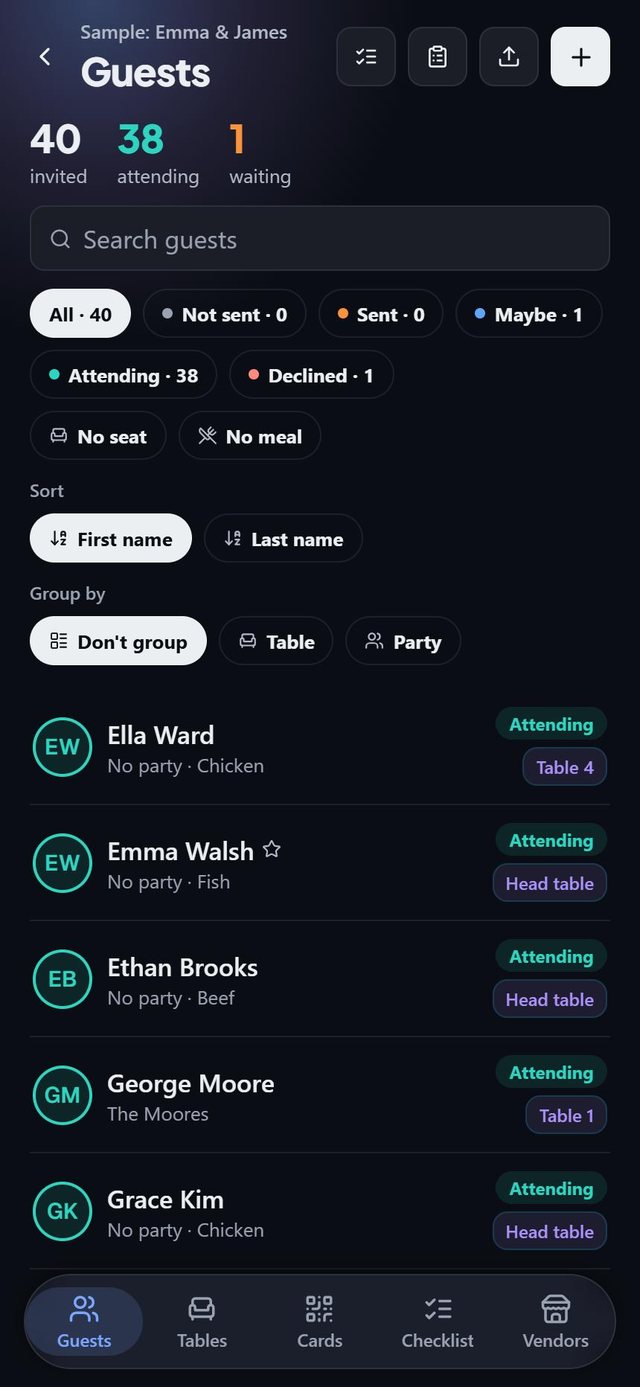
SeatSpot's RSVP states were built for exactly this split: Not sent means you have not invited them yet, Sent means the invitation is out and you are waiting.
- Put the A list in. Paste your names into the guest list; everyone arrives as Not sent. When the envelopes go out, filter the list by Not sent, turn on selection, tap Select for everyone on screen, and change them to Sent in one step. See RSVP tracking.
- Keep the B list out of the app until you invite them. SeatSpot plans a seat for every guest who has not declined, invited or not, so adding B-list names early would make the room look full. Keep the ranked B list in your own notes for now.
- Record answers as they arrive. Mark each guest Attending or Declined. Declining releases any seat the guest held. The Guests tab shows attending and waiting at the top; take both from your room's capacity and you have your open seats.
- Invite the next wave. Paste the next names from your B list; anyone already on the list is skipped, so pasting the same names twice does no harm. Mark them Sent when their invitations go out. See paste a list and bulk edit.
- Close the list. After the last reply date, select any guests still on Sent and mark them Declined together.
SeatSpot is available on Google Play and the App Store.
Questions people ask
When should B-list wedding invitations go out?
As declines come in, starting a week or two after the A list is mailed, and ideally no later than about eight weeks before the wedding. Give the B wave its own, later reply date.
How many B-list guests can I invite?
No more than your open seats: room capacity minus everyone who has said yes minus everyone who has not answered yet. Rank the B list so each freed seat goes to the next name.
Should B-list guests get a save-the-date?
No. Send save-the-dates only to guests you are certain to invite.
What if a B-list guest finds out?
Tell them the truth in one sentence: you were working within the venue's capacity, and you are glad there was room. Do not invent a lost envelope for more than one or two people.
Created by Mariusz Bednarczyk and fact-checked against the sources above. He reads each post after publication. How we make posts: About the blog.
Plan it next
Related guides
- How to cut your wedding guest list (with the math)
- What % of wedding guests RSVP yes? About 72 per 100
- How to follow up on wedding RSVPs
Start here: How to make a wedding seating chart, step by step
More in Guest list and RSVPs