
How to cut your wedding guest list (with the math)
To cut a wedding guest list, write down rules that apply to everyone, sort the names into an A list (must come), a B list (want there) and a C list (only if there is room), then invite as many as your venue holds once you allow for declines. If 15 percent of invitees say no, a venue for 150 lets you send about 176 invitations, not 150.
How do you cut a wedding guest list without offending anyone?
You make the cut with a rule, not a name. A rule you apply to everyone is easy to explain and hard to take personally; a single name dropped from an otherwise complete group is the opposite. The guides we read suggest these rules, roughly from least to most painful:
| Rule | Who it removes | Suggested by |
|---|---|---|
| No plus-ones except married, engaged or long-term partners | Dates of single guests | Zola, Bride Club ME, Style Me Pretty |
| Adults only, with at most an exception for very close family | Children of guests | Zola, Bride Club ME, Style Me Pretty |
| Friends you have spoken to in the past year | Lapsed friends | WeddingWire, Bride Club ME |
| First cousins as the family limit | Second cousins and beyond | WeddingWire |
| No co-workers or friends of friends | Work and acquaintance invites | Zola |
| Parents' friends only if you have known them most of your life | Your parents' social circle | WeddingWire |
Pick the rules you can live with and apply each one without exceptions. Style Me Pretty makes the point for plus-ones, and it holds for every rule: the first exception is the one people notice.
What are the A list, B list and C list?
The tier method turns one painful decision into several easy ones. WeddingWire's version uses green, yellow and red; Style Me Pretty calls them A, B and C. Either way:
- A list: people whose absence would be unthinkable. Immediate family, the wedding party, your closest friends. These are invited no matter what.
- B list: people you really want there. They get every seat the A list leaves free.
- C list: people you would invite only if there is room. They are the first to go.
Count the A list first. If the A list alone fills the venue, no tiering will save you and the rules above have to do the work, starting on the A list itself.
How many invitations should you send for your venue's capacity?
Not everyone you invite will come, so you can send more invitations than you have seats. WeddingWire suggests planning for 15 to 20 percent of the list not attending. Divide your capacity by the share you expect to say yes:
| Venue capacity (guests) | Invitations at 15% declines | Invitations at 20% declines |
|---|---|---|
| 100 | 117 | 125 |
| 150 | 176 | 187 |
| 200 | 235 | 250 |
Our post on how many invited guests will say yes gets 120 invitations for 100 seats instead of 117. The two numbers come from different inputs, not different methods: that post uses a 2026 benchmark in which about 17 percent of invitees reply no, while this table uses the 15 percent rule of thumb. Both count everyone who has not declined as coming. The gap is three invitations per 100 seats; if your venue has a hard limit, send the lower number.
We rounded down, so each figure keeps you at or just under capacity. Use the 15 percent column unless you have a reason to expect more declines, such as a destination wedding or many guests flying in. The more cautious column means that if more people say yes than you planned for, you are a few chairs over, not twenty.
Our post on how many invited guests will say yes has benchmark reply rates if you want a better estimate than a flat percentage.
A worked example: 220 names, 150 seats
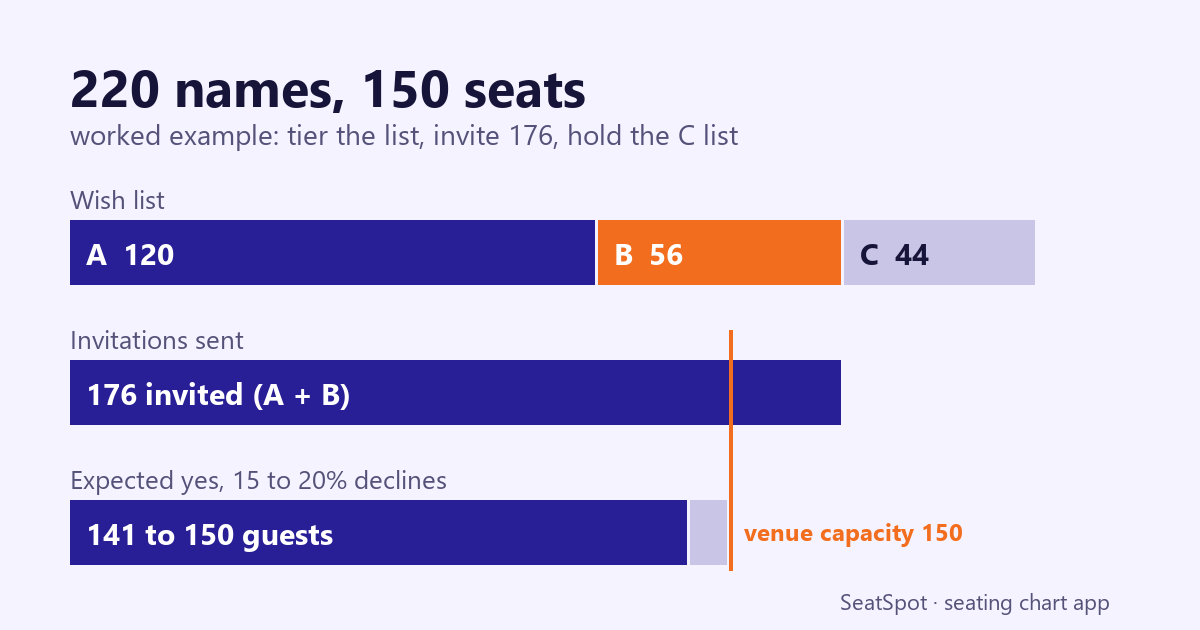
Say your combined wish list has 220 names and the venue holds 150.
- Apply the rules. Suppose they settle the A list at 120 names: family, wedding party and close friends.
- Work out the budget. At 15 percent declines, 150 seats allow 176 invitations. That leaves 176 - 120 = 56 for the B list.
- Rank the rest. Your top 56 non-A names become the B list. The remaining 44 are the C list.
- Send A and B together. 176 invitations go out. If 15 percent decline, about 150 say yes; if 20 percent decline, about 141 do.
- Hold the C list. If declines come in faster than expected, invite C-list names as seats open.
Bride Club ME suggests timing later invitations so they do not look like last-minute additions. That only works if the C list goes out well before the RSVP deadline, so set that deadline early enough to leave room for a second round.
How do you split the list fairly between families?
Give each side a fixed share of the B list before anyone starts naming people. WeddingWire's approach for the last few spots is to take turns picking from the remaining names. If parents are paying, Zola suggests agreeing up front how many guests they may invite, so their list does not grow while yours shrinks.
Keep the list itself private until it is final. Zola recommends sharing it only with your partner, or with clear limits, because every draft that circulates creates someone who saw their name and then did not get an invitation.
How do you tell someone they are not invited?
Usually nobody asks, because nobody saw the draft list. When someone does ask, point to the constraint, not the person. "Our venue holds 150, so we kept it to family and close friends" is true, simple and hard to argue with. Zola and Style Me Pretty both suggest leaning on venue size or budget in exactly this way.
Two more things help. First, being invited to someone else's wedding does not oblige you to invite them back, as Style Me Pretty notes. Second, if you have cut a large circle, such as work friends, a casual get-together after the wedding is a kind way to celebrate with them, which Bride Club ME suggests.
Doing this in SeatSpot
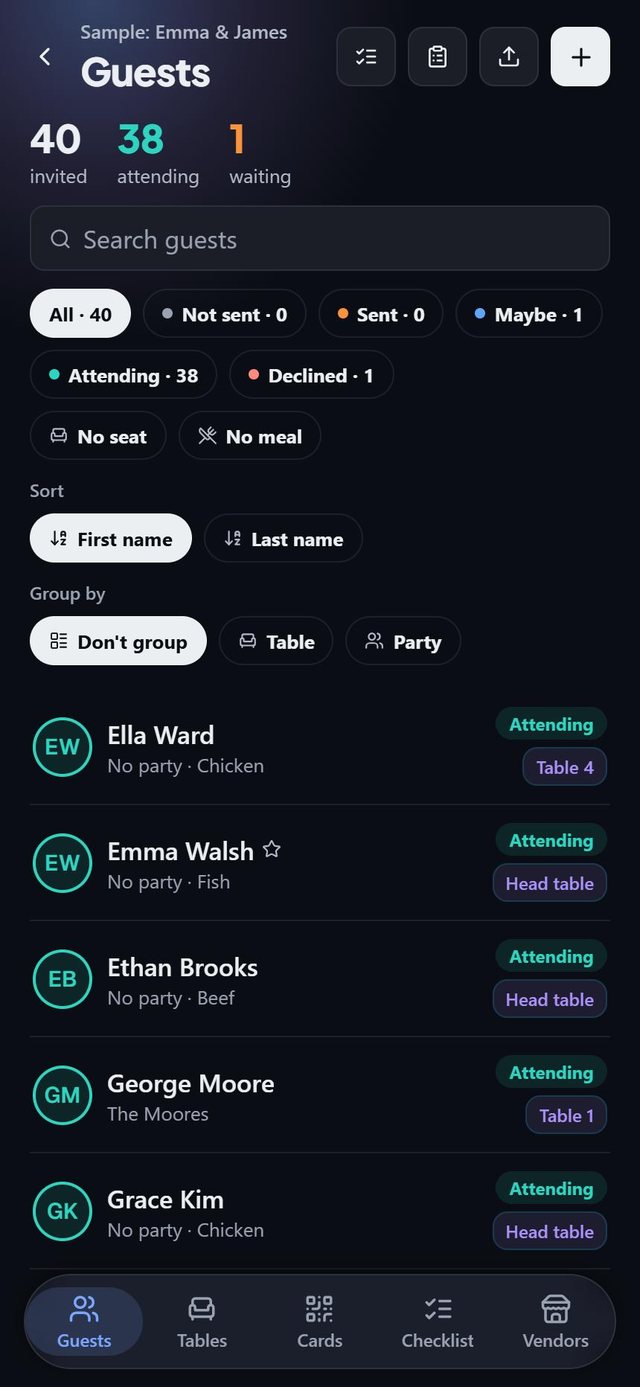
SeatSpot keeps the tiers in the RSVP status, so the list you invite from and the list you seat from are the same list.
- Add the whole wish list at once. Use Paste a list of names: one name per line from Notes, a text or an email. "Anna & Tom Kowalski" becomes two guests in the Kowalski family and "John Smith +1" adds John with a plus-one to name later. Everyone arrives as Not sent.
- Mark the sides. At a wedding each guest's screen asks whose side they are from, and the Guest report shows the split, for example Emma's 62 · James's 58 · Both 10. That number settles who may still invite whom.
- Send the A and B lists. Filter the guest list by RSVP status, select the guests you are inviting and change their RSVP together to Sent. The C list stays on Not sent, so it is always one filter away. See RSVP tracking.
- Watch the counts. The Guests tab shows invited, attending and waiting at the top. When declines come in, marking a guest Declined releases any seat they held, and you can see at a glance how many C-list invitations the room can take.
- Seat what is left. Once the replies are in, the list is already your seating list. To size the tables, see how many guests fit at a round table.
The free plan holds up to eight guests per event, which is enough to try this; a full guest list needs Pro or a one-event pass. SeatSpot is available on Google Play and the App Store.
Questions people ask
How many people should I invite if my venue holds 150?
About 176, if you expect 15 percent of invitees to decline, or up to 187 at 20 percent. Keep a C list ready rather than inviting the higher number up front.
Is it rude to have an adults-only wedding?
No. It is one of the most common ways to shorten a list. Say so clearly on the invitation or your website and name exactly who is invited on each envelope. Making exceptions for immediate family is common; making them for anyone else is where it starts to look personal.
Who should be cut first from a wedding guest list?
Plus-ones of single guests, then people you have not spoken to in the past year, then co-workers and friends of friends. Those cuts follow a rule, so they are the easiest to explain.
When should B-list invitations go out?
With the A list if your numbers allow it, as in the example above. Hold back only the C list, and send it as declines arrive, early enough that late invitations still come before the RSVP deadline.
Created by Mariusz Bednarczyk and fact-checked against the sources above. He reads each post after publication. How we make posts: About the blog.
Plan it next
Related guides
- Wedding B list: when to send second-round invites
- What % of wedding guests RSVP yes? About 72 per 100
- How to follow up on wedding RSVPs
Start here: How to make a wedding seating chart, step by step
More in Guest list and RSVPs