
Wedding singles table: should you have one?
Usually not. A wedding singles table groups people by one fact about their lives, and the etiquette writers we checked all advise against it; the better plan is to seat single guests with people they already know, and never as the only single person at a table of couples.
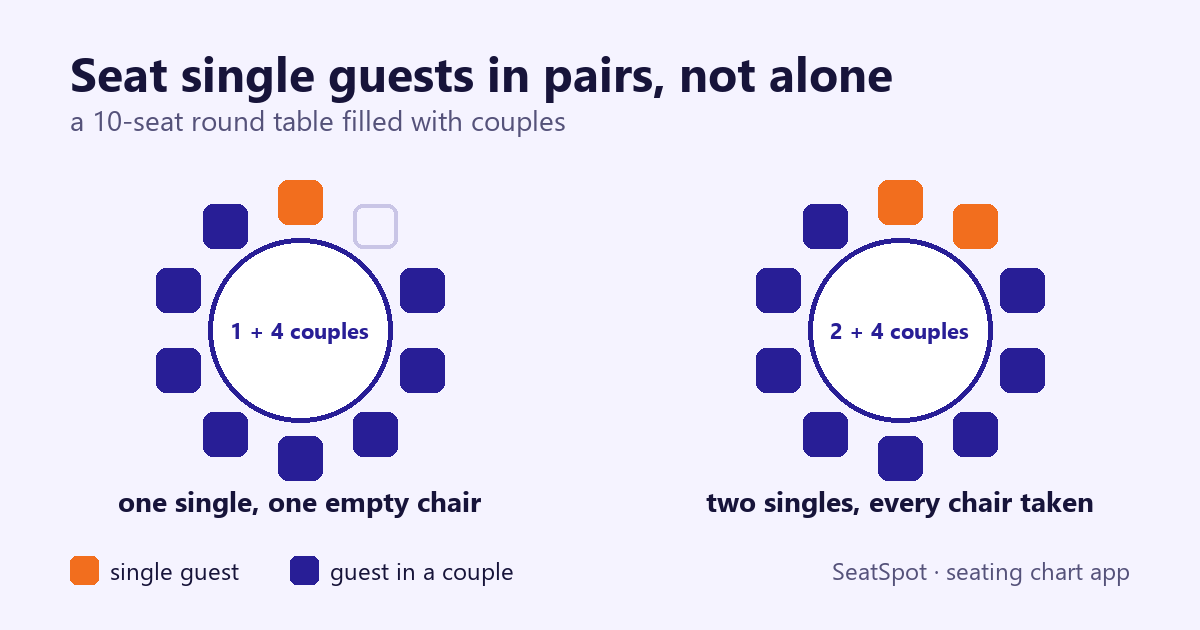
That second rule is the one couples miss, and it has a simple arithmetic side we work through below: at a table of even size, one single guest among couples almost always leaves an empty chair right next to them.
Should you have a singles table at a wedding?
The advice is close to unanimous. Here is the common idea, tested against what each source actually says:
| The common idea | What the source says | Verdict |
|---|---|---|
| "Put all the singles together so they can meet someone." | New Orleans Magazine's etiquette column says it can look like a low-key fix-up or a surprise blind date, which nobody wants. | Myth |
| "It is just a practical way to fill a table." | WeddingWire lists lumping single guests together at a singles table among its reception seating don'ts. | Myth |
| "Singles are fine anywhere as long as the table is full." | Shutterfly says one single guest at a table full of couples is best avoided. | Myth |
| "Seat singles where they know people." | WeddingWire suggests seating them with tablemates they know from other parts of life; Shutterfly suggests grouping guests by how you know them. | True |
| "Mix couples and singles." | Shutterfly recommends a mix of couples and singles at each table. | True |
So the singles table is not banned; it is simply the wrong reason to put people together. If ten single friends from college would happily sit together anyway, that is a college table that happens to have no couples at it. The test is how they know each other, not their relationship status.
Is a singles table rude?
It is not rude in the sense of a breach of manners, but it often lands badly. The New Orleans Magazine column puts it plainly: guests can read it as a setup. A single guest who came to celebrate you, not to be matched, can feel the table was planned around their status rather than their friendships. The same column's alternative is to seat single guests as you would anyone else, by personality and interests.
Where should you seat single guests at a wedding?
Three rules cover almost every case:
- With the group they belong to. College friends with college friends, coworkers with coworkers, cousins with family. This is the "how you know them" grouping Shutterfly describes.
- In twos or more. A single guest with at least one other single person at the table, or with a close friend, never as the lone single.
- Next to someone with something in common. Shutterfly suggests seating single guests beside someone who shares their interests.
The awkward cases are the single guests who know nobody: a neighbor, a gym friend, a former colleague. Seat two of them together at a friendly mixed table rather than one each at two tables. They at least start the evening with someone in the same position.
What happens with one single guest at a table of couples?
Here is the arithmetic. Couples take seats in twos, so at a table with an even number of chairs, an odd number of single guests leaves one chair that couples cannot fill. More often than not, the empty chair ends up beside the single guest, which is exactly the look you were trying to avoid.
| Single guests at the table | 10-seat table: couples that fit | 10-seat table: empty chairs | 8-seat table: couples that fit | 8-seat table: empty chairs |
|---|---|---|---|---|
| 1 | 4 | 1 | 3 | 1 |
| 2 | 4 | 0 | 3 | 0 |
| 3 | 3 | 1 | 2 | 1 |
| 4 | 3 | 0 | 2 | 0 |
| 5 | 2 | 1 | 1 | 1 |
| 6 | 2 | 0 | 1 | 0 |
The rule that falls out of it: put single guests at couples tables in even numbers. Two, four or six fill the table exactly; one, three or five leave a gap unless another single guest, a child or a parent fills it. WeddingWire puts the practical maximum at about 8 to 10 guests a table, so those are the two sizes that matter. For the space each size needs, see how many guests fit at a round table.
A worked example: 14 single guests, no singles table
Take a wedding with 14 single guests and 13 couples who belong to the same friend groups, seated at 10-seat rounds. The single guests are 6 college friends, 4 coworkers, 2 cousins, and 2 people who know nobody else: a neighbor and a friend from a running club.
| Table | Single guests | Couples | Seats used | Lone single? |
|---|---|---|---|---|
| 7: college friends | 6 | 2 | 10 of 10 | No |
| 8: coworkers | 4 | 3 | 10 of 10 | No |
| 9: cousins and family | 2 | 4 | 10 of 10 | No |
| 10: neighbors and friends | 2 | 4 | 10 of 10 | No |
| Total | 14 | 13 | 40 of 40 |
Every table is full, every single guest sits with someone they know or with one other person in the same position, and nobody was seated by relationship status. The neighbor and the runner are the only ones who did not arrive knowing someone, so they sit side by side at the table of friendly couples from the neighborhood.
Doing this in SeatSpot
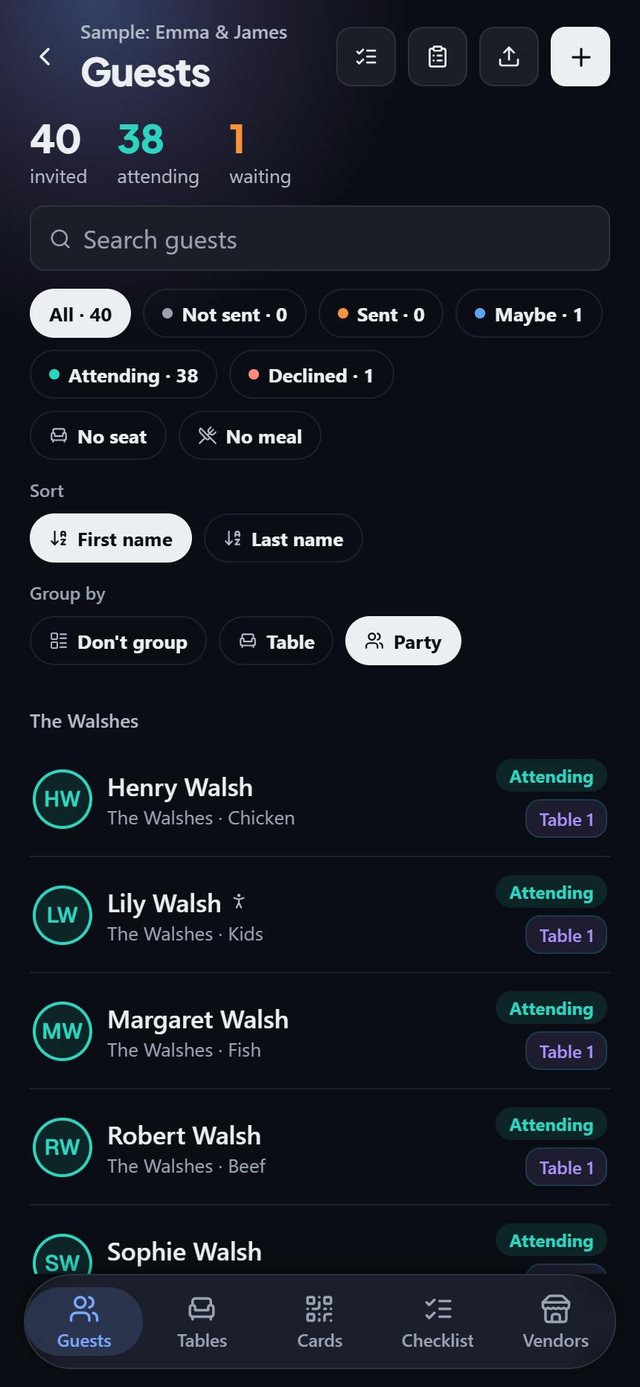
The app has no "single" label, and it does not need one. Friend groups do the work.
- Make each group a party. On a guest's screen, type a party name such as "College" or "Work". A party is any group who belong together, and it is what parties are for: couples and single guests from the same circle go in the same party.
- Run Smart fill. At a wedding it keeps each party together, placing the largest group first at the smallest table that fits all of them, and it only seats guests marked Attending. See smart fill.
- Check the rings. On the floor plan, every occupied seat is ringed in its party's color, and a guest with no party has no ring. A single seat without a ring among couples' colors is the lone single you are looking for.
- Fill gaps by hand. Tap an empty chair: the seat picker lists people whose party is already at that table first, so a second college friend is one tap away.
- Read plan check. It tells you when a party is spread across tables. If the split is deliberate, tick Sitting apart is intentional and it stops mentioning it. See plan check.
For the rest of the plan, from the guest list to the printed chart, our wedding seating chart guide walks through every step. SeatSpot is available on Google Play and the App Store.
Questions people ask
What if most of our single friends know each other?
Then seat them together, and call it what it is: a friends table. The objection is to grouping strangers by status, not to friends sitting together.
Should single guests get a plus-one so they are not alone?
That is a budget and headcount decision, not a seating one. If a single guest knows nobody else at the wedding, a plus-one solves the seating problem as well; if they know a group, seating them with it usually does the same job for free.
Is it fine to put one single guest at a table of couples they know well?
Yes, if they know the couples well. The concern in the sources is the single guest surrounded by couples they do not know; a close friend among close friends is a different situation. Check the chair count, though: an odd number of singles at an even table still leaves a gap.
Can we use the empty chair for someone else?
Yes. A child, a widowed grandparent or anyone else coming on their own fills an odd seat as well as a single friend does. The table above only counts adults in couples and single guests.
Created by Mariusz Bednarczyk and fact-checked against the sources above. He reads each post after publication. How we make posts: About the blog.
Plan it next
Related guides
- How to seat wedding guests who don't get along
- Where do kids sit at a wedding?
- How to make a wedding seating chart, step by step
Start here: How to make a wedding seating chart, step by step
More in Seating charts and etiquette