
How to seat wedding guests who don't get along
To seat wedding guests who don't get along, put them at different tables and decide, pair by pair, how much distance each feud needs. A mild grudge only needs separate tables; exes and a family feud need opposite ends of the room, and those pairs should be placed first, because only the end tables are far enough from everything else.
This guide turns that into steps: build the list of pairs, grade each one, place them in the right order, then check who sits around each guest. A worked example with 14 tables shows the distances.
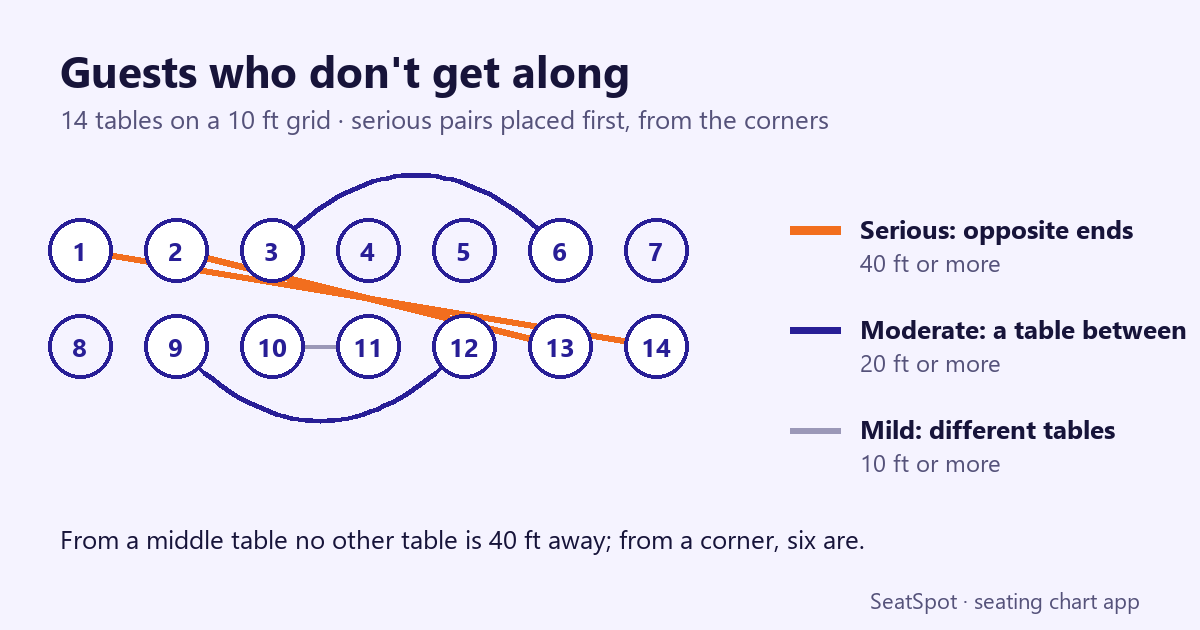
How to seat guests who don't get along at a wedding?
The order matters more than any single rule. We use six steps:
- List every pair. Write down who should not share a table, with one line per pair.
- Grade each pair as mild, moderate or serious (the table below says what each grade means).
- Place the serious pairs first, starting from the tables at the ends of the room.
- Place the moderate pairs with at least one table between them.
- Seat everyone else, keeping mild pairs at different tables.
- Check the neighbors of every guest on your list, not only their tablemates.
In the other order, the far tables are full by the time the serious pair comes up.
Who doesn't get along? Build the list first
The pairs that cause trouble are often the ones you have not heard about. Easy Weddings suggests checking privately with parents, siblings or close relatives before the chart is final, so they can flag difficult dynamics you would never guess.
Woman Getting Married makes a similar point near the end of its list of seating mistakes: showing the draft chart to your parents is a cheap way to catch an old falling-out before it reaches the reception.
Ask: "Is there anyone on this list who should not sit near anyone else?" Write each answer down as a pair.
How far apart should feuding relatives sit?
Woman Getting Married recommends opposite sides of the room for a long-running family feud and warns that a wedding will not fix it. That is the serious end of the scale; for milder cases we think different tables are enough. We turned that into three grades. The distances assume 60-inch rounds on a 10-foot grid, center to center, in two rows of seven; your room will differ, so treat them as a guide:
| Grade | Typical pair | Our rule | Distance on the grid (ft) |
|---|---|---|---|
| Mild | Two coworkers who clash | Different tables; neighbors are fine | 10 or more |
| Moderate | Siblings in a dispute, former best friends | At least one table between them | 20 or more |
| Serious | Exes, a family feud, a new spouse and the ex's relatives | Opposite ends of the room | 40 or more |
The grid also shows why serious pairs go first. We measured how many tables are far enough away from two starting points:
| Starting table | Tables 20 ft or more away | Tables 40 ft or more away | Farthest table (ft) |
|---|---|---|---|
| End of a row (table 1) | 10 of 13 | 6 of 13 | 60.8 |
| Middle of a row (table 4) | 8 of 13 | 0 of 13 | 31.6 |
From a middle table, nothing in the room is 40 feet away. If one half of a serious pair is already sitting in the middle, the other half cannot get far enough, whatever you do. Start them at the ends.
Where to seat exes at a wedding?
At different tables that are not next to each other, and ideally out of each other's line of sight during the toasts. Woman Getting Married lists all three: not the same table, not an adjacent one, and nowhere they would catch each other's eye during the speeches. Easy Weddings adds that separate tables spare them forced small talk. If one of them brings a new partner, give that couple the quieter end.
Check the neighbors, not only the table
Woman Getting Married describes a mistake that a table-by-table check misses: a remarried parent's new spouse at a friendly table that is surrounded by the other parent's closest relatives. Nobody at that table is on a conflict list, yet the evening is still uncomfortable.
So for every guest on your list, look at the tables around theirs, not just the one they sit at. For divorced parents in particular, our guide to seating divorced parents at a wedding covers the front tables.
A worked example: 140 guests, 14 tables, 5 pairs
The wedding has 140 guests at 14 rounds of 10: tables 1 to 7 in the front row and 8 to 14 behind them, on the 10-foot grid. The couple has five pairs on the list:
| Pair | Grade | Tables | Distance (ft) |
|---|---|---|---|
| Two exes from the couple's friend group | Serious | 1 and 14 | 60.8 |
| The groom's stepfather and his father's sister | Serious | 2 and 13 | 41.2 |
| Two brothers who fell out over a business | Moderate | 3 and 6 | 30.0 |
| Two former best friends | Moderate | 9 and 12 | 30.0 |
| Two coworkers who clash | Mild | 10 and 11 | 10.0 |
The two serious pairs went in first, from the corners of the room: tables 1 and 14 are opposite corners, and 2 and 13 are the next tables in. The moderate pairs then took tables three apart in each row, which leaves two tables between them. The mild pair could sit side by side. Every pair clears its grade, and tables 4, 5, 7 and 8 hold nobody from the list, so the rest of the seating chart can be built around them.
The last check was the neighbors. The groom's stepfather at table 2 sits next to tables 1, 3, 8, 9 and 10, and none of those holds his wife's former in-laws, so he passes.
Should you talk to guests who don't get along before the wedding?
Sometimes. WeddingWire suggests a quiet word with a guest you cannot leave off the list, asking for a calm day, while admitting it can make things worse. It also suggests handing any flare-up on the day to the coordinator or a trusted friend, such as the maid of honor or best man, rather than dealing with it yourself.
Offbeat Wed is calmer about it: most guests will not cause a scene, and little of the evening happens at the table anyway. If you are worried, it suggests asking someone in the wedding party to keep an eye on the group. Brief that person with the list of pairs and their table numbers.
Doing this in SeatSpot
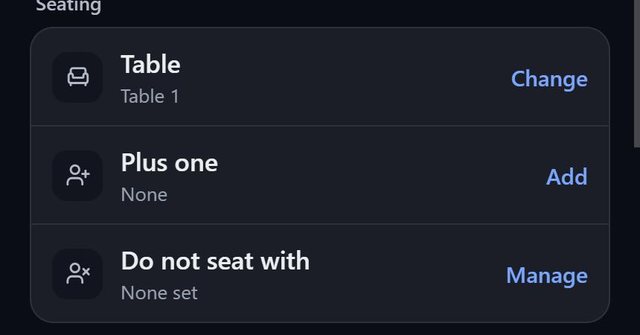
The conflict list lives on each guest, so the app can check it every time someone moves.
- Enter each pair once. Open a guest and add the other person under Do-not-seat-with. The rule is saved on both guests, so it does not matter which one you start from. See conflicts.
- Seat the serious pairs by hand. Tap a seat on an end table and pick the guest. In that list, anyone with a conflict at the table drops to the bottom with a note such as Conflict with Anna; they are still there, because you may know something the app does not.
- Let smart fill do the rest. It avoids tables that would create a conflict and, when every table with room already holds one half of a pair, it seats the guest anyway and reports it in the bar: "2 despite conflicts". One tap on Undo puts the room back. See smart fill.
- Check the distances yourself. The app checks conflicts table by table, not by distance, so a pair at neighboring tables is not flagged. Use Find on the floor plan to highlight where each guest of a serious pair sits and see how far apart they really are.
- Read plan check before you print. Two guests who asked not to sit together at one table always count as a problem in plan check, whatever the date. See plan check.
For the full seating chart from the first guest to the final print, see our step-by-step wedding seating chart guide. SeatSpot is available on Google Play and the App Store.
Questions people ask
What if feuding guests end up at the same table?
Move one of them before printing. If it happens on the day, a coordinator or a friend from the wedding party can quietly swap one guest to a spare seat elsewhere, which is easier if you left a few chairs free.
Should exes be told where the other is sitting?
There is no need to announce it. A guest who asks can be told they are well apart.
How many conflict pairs is too many?
There is no fixed number, but the far ends fill up first. On our 14-table grid, 12 tables have a partner table 40 feet or more away; only the two middle tables (4 and 11) do not. One table can hold halves of several pairs, as long as those guests have no conflict with each other, so the limit is usually the seats at each end, not the number of pairs. When the ends are full, the remaining pairs have to settle for the moderate distance.
Created by Mariusz Bednarczyk and fact-checked against the sources above. He reads each post after publication. How we make posts: About the blog.
Plan it next
Related guides
- Wedding singles table: should you have one?
- How to make a wedding seating chart, step by step
- Where do kids sit at a wedding?
Start here: How to make a wedding seating chart, step by step
More in Seating charts and etiquette