
Where do divorced parents sit at a wedding?
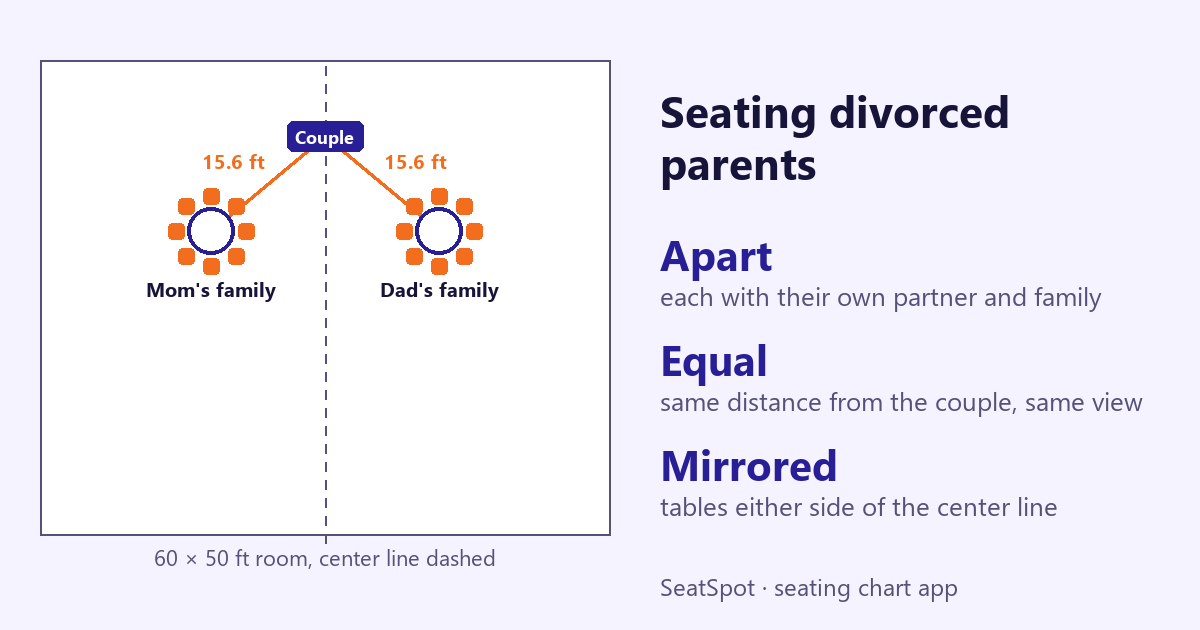
Seat divorced parents apart, each with their own partner and family, and give both the same standing: the same distance from the couple, the same view, neighbors of the same importance. How far apart depends on how well they get along, from the same front row to opposite sides of the room.
What is the basic rule for seating divorced parents?
The guides we read agree on one principle: neither parent gets the better seat. A stationery company's etiquette guide calls it equal standing, judged by sightline, distance from the couple and the quality of the neighbors, and puts it bluntly: never seat one parent closer to the couple than the other. A UK stationer makes the same point from the other side: do not give one parent the important table while the other sits with strangers. Separate tables are fine. A visibly worse table is what hurts.
Two more points come up across the guides:
- Divorced parents do not have to sit together, at the ceremony or the reception.
- Decide in advance and tell each parent before the day. Showing each parent the layout beforehand removes the guesswork, so nobody is left working out where to go.
How should divorced parents sit at the ceremony?
Ceremony seating is rows, so the options are fewer. The UK stationer's starting point is to seat both parents in the same row, each with their new partner if they have one, and notes that the two couples can sit on different sides of the room. Some couples put the mother in the first row and the father in the second; the guide treats that as personal preference and suggests asking both parents beforehand whether they mind.
That gives a simple range, from closest to furthest apart:
- Parents who get along: both in the front row, each with their partner.
- Parents with some tension: one in the front row and the other in the row behind, each with their own family group.
- Parents who cannot be near each other: one on each side of the room, each with their own partner and relatives around them.
How should divorced parents sit at the reception?
Tables give you more room to work with than rows. Each parent can host a table of their own family and friends, and the two tables only need to be equal, not next to each other.
Here is how the advice from the three sources lines up by relationship. The table is our summary, not a rule from any one source.
| How they get along | Ceremony | Reception | What to check |
|---|---|---|---|
| Friendly | Same front row | One shared table, or separate tables both near the front | Both tables equally close to the couple |
| Polite but tense | Front row and the row behind | Separate tables, both near the front | Neither table blocks the other's view |
| Cannot be near each other | Opposite sides of the room | Separate tables on opposite sides of the room, mirror positions | Equal distance to the couple, measured on the plan |
Traditionally, parents do not sit at the head table at all; they get honored tables next to it. A family head table with both sets of parents is possible, but the stationery guide warns it gets complicated when divorced parents are not on speaking terms, and says it works best for weddings under 80 guests. A UK planning site lists alternatives to a traditional top table: a sweetheart table for just the couple, separate family tables, a table for the wedding party, or a larger oval table that spaces people out while keeping family close.
Where do stepparents sit?
With the parent they are married to. Both stationery guides say to seat each stepparent or new partner with their spouse, and the etiquette guide adds that there is no required order for all four parents and stepparents. At the ceremony a stepparent sits beside their spouse in whichever row that parent has; at the reception they sit at that parent's table.
How do you check that both tables are equal?
"Equally close" is easy to say and easy to get wrong in a room that is not square. The reliable way is to measure it on a floor plan drawn to scale.
Put the couple's table on the center line of the room, then place the two parent tables as mirror images across that line. Mirror positions are the same distance from the couple by definition. A worked example in a 60 by 50 foot room, measured in feet from the left wall and the front wall:
| Table | Position across | Position back | Distance to the couple |
|---|---|---|---|
| Couple | 30 ft | 8 ft | – |
| Mom's family | 18 ft | 18 ft | 15.6 ft |
| Dad's family | 42 ft | 18 ft | 15.6 ft |
| A table 3 ft further back | 42 ft | 21 ft | 17.7 ft |
The distance is the straight line between table centers: 12 feet across and 10 feet back gives the square root of 144 plus 100, about 15.6 feet. Moving one table just 3 feet back puts it about 2 feet further from the couple than the other, which is easy to miss by eye.
Distance is not the whole test. Also check that a pillar, the bar or the band does not block one table's view, and that neither table is stuck by the kitchen doors. The etiquette guide notes that round or U-shaped rooms often create two equal zones near the couple on their own. In a long, narrow room where mirror positions are not possible, it suggests one parent near the front and the other in a featured spot to the couple's immediate left or right.
What should you tell the parents, and when?
Talk to each parent separately and early. The UK planning site suggests raising seating before the plan is final and telling family in advance so nothing comes as a surprise. A few points from the guides:
- Ask each parent beforehand whether they mind the arrangement. Asking is not the same as letting them decide.
- A financial contribution does not automatically give a parent a say over seating; agree on that before you accept the money.
- Pick someone neutral, such as a sibling, a trusted relative or your planner, who can step in if tension rises, and brief them beforehand.
- Show each parent where they will sit before the day.
Doing this in SeatSpot

SeatSpot plans reception tables, not ceremony rows, so use it for the reception half of this plan.
- Mark each guest's side. At a wedding, every guest's screen asks whose side they are from, using the couple's names from the event title, plus Both. Put each parent's relatives and friends on the right side, so you can see the split in the guest report.
- Add a do-not-seat-with rule between the two parents, and between any other pair who should not share a table. The rule is stored on both guests, a table with a conflict is flagged on the floor plan, and seating a group onto a table warns you first. See keeping guests apart.
- Build each parent's table. Give the table a group name such as "Family" in its properties, so the parent tables are easy to pick out while you plan.
- Place the tables as mirror images. Set the room to your venue's size in feet, then drag the two parent tables to matching spots either side of the couple's table, using the floor plan dot grid to line them up. Switch on Lock position for both so a stray drag later does not undo the balance.
- Run Smart fill for everyone else. It seats the remaining confirmed guests and avoids tables that would create a conflict. When it cannot avoid one, it seats the guest anyway and tells you, so check its summary.
For table sizes and spacing between tables, see how many guests fit at a round table.
Questions people ask
Do divorced parents have to sit together at the wedding?
No. Separate rows at the ceremony and separate tables at the reception are both normal. What matters is that both seats are equally good.
Can divorced parents sit at the head table?
Only if they are comfortable together. Otherwise give each parent their own table near the front, or use a sweetheart table for the couple so there is no head table to share.
Where does the father sit if the mother has the front row?
Some couples seat him in the second row with his partner. If the parents are friendly, both can share the front row.
How far apart should divorced parents sit at the reception?
There is no fixed distance. For parents who cannot be near each other, put them on opposite sides of the room, each the same distance from the couple. For parents who get on, neighboring tables or even one shared table are fine.
Created by Mariusz Bednarczyk and fact-checked against the sources above. He reads each post after publication. How we make posts: About the blog.
Plan it next
Related guides
- Where do the bride and groom's parents sit?
- How to seat wedding guests who don't get along
- Where do kids sit at a wedding?
Start here: How to make a wedding seating chart, step by step
More in Seating charts and etiquette