
Where do the bride and groom's parents sit?
The bride and groom's parents sit either at the head table with the couple or at the tables closest to it, which Shutterfly calls the tables of honor. Which one you choose depends on the shape of your couple's table, and on whether the two families would rather share one table or each host their own.
Below are the three common setups, who else joins the parents, and a distance table we worked out that shows why the number of tables in your front row decides whether one parents' table or two fits best.
Where do the bride and groom's parents sit at the reception?
There are three usual answers, and all three keep the parents near the couple:
| Setup | Where the parents sit | Works well when |
|---|---|---|
| Traditional head table | At the head table, beyond the maid of honor and best man | Both families are close and the head table is long enough |
| Head table for the wedding party | A parents' table directly in front of it | You want the attendants up front with you |
| Sweetheart table | One or two tables of honor nearest the couple | It is just the two of you up front |
Bridebook describes the traditional head table order: the couple in the middle, the maid of honor and best man on either side of them, and each set of parents beyond those attendants. Its alternative swaps the parents across so each one sits beside someone from the other family, which can help two families who have only just met.
The second and third setups move the parents to their own table. Paperlust says that table should be one of the best in the room: near the front, with a clear view of the couple, and away from the bar and the DJ.
Do parents sit at the head table?
They can, but they do not have to. Shutterfly lists both options, a seat at the head table or a table of honor next to it. A head table that seats the couple, two attendants and four parents already needs eight chairs in a line, and partners of the attendants are left elsewhere. That is one reason many couples keep the head table for the wedding party and give the parents a table of their own, where they can sit with their own guests.
If you go the other way and put the parents at the head table, decide early whether step-parents join them. Shutterfly says that is the couple's call.
Should both sets of parents sit together?
Not necessarily. Paperlust says the two sets do not have to share a table and that many couples give each set its own table with their close family and friends, which is more common at larger weddings. One shared table suits two families who already know each other; two tables suit families who would each rather host their own relatives.
Whoever is at the parents' table, Paperlust suggests filling the remaining chairs with grandparents who are not at a table of their own, the officiant and their spouse if invited, and siblings who are not in the wedding party. Shutterfly adds close relatives and family friends to the same tables of honor.
How far is the parents' table from the couple?
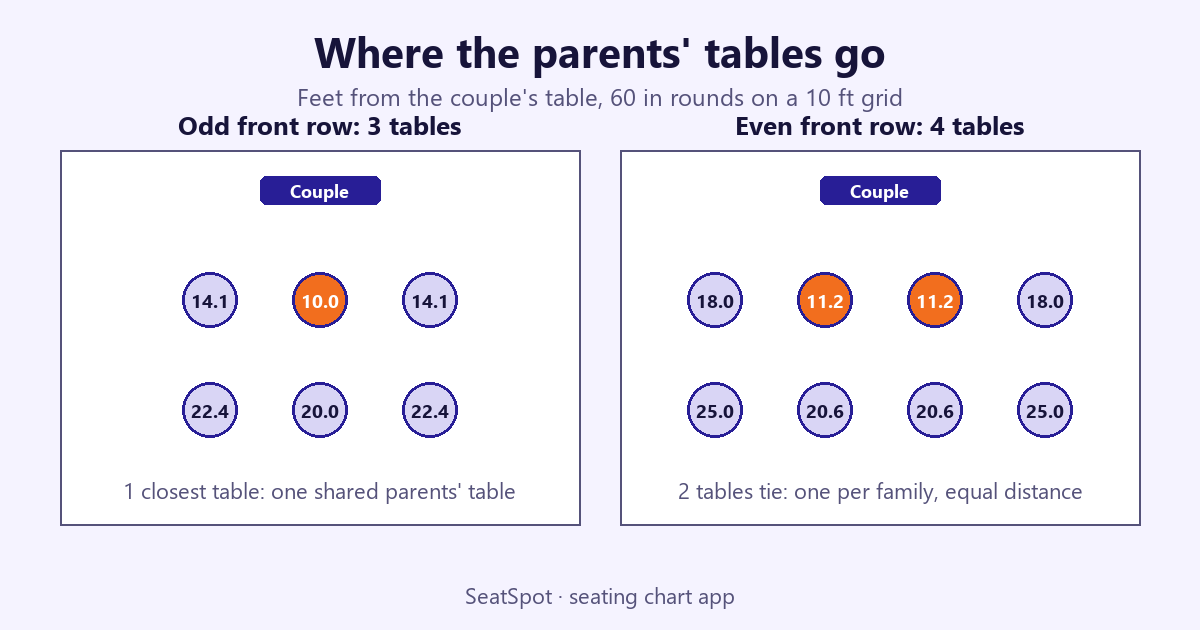
This is the part the etiquette guides leave to you, so we measured it. Our example puts 60-inch round tables on a 10-foot grid, center to center, with the first row 10 feet in front of the couple's table. The grid is an assumption for the example, not a rule; your venue's spacing will differ, but the pattern holds at any spacing.
| Front row | Table position | Distance to the couple's table (ft) | Closest? |
|---|---|---|---|
| 3 tables | Middle | 10.0 | Yes, alone |
| 3 tables | Left or right of middle | 14.1 | No |
| 3 tables | Second row, middle | 20.0 | No |
| 4 tables | Two middle tables | 11.2 each | Yes, tied |
| 4 tables | Two outer tables | 18.0 each | No |
| 4 tables | Second row, two middle tables | 20.6 each | No |
Each distance is the square root of the sideways offset squared plus the distance forward squared. For the middle tables of a four-table row that is the square root of 5 squared plus 10 squared, or 11.2 feet.
What the table shows:
- An odd front row has one best table. It sits straight in front of you and nothing else ties with it. That is the place for a single shared parents' table.
- An even front row has two equal tables. Neither family gets the closer seat, because there is no closer seat. That is the place for two parents' tables, one per family.
- If your room forces an odd row and two parents' tables, use the two tables either side of the middle (14.1 feet each) and give the middle one to the grandparents, rather than putting one family in the middle and the other off to the side.
The same check works for a sweetheart table: measure from its center instead of the head table's.
Where do divorced parents sit at the reception?
At separate tables, each with their own partner and family. Shutterfly suggests different tables of honor for each parent and their spouse. Paperlust suggests opposite sides of the room with equal prominence and warns against seating one parent closer to the couple than the other, which is exactly what the even front row in our table gives you. Our post on how to seat divorced parents at a wedding goes through the ceremony as well as the reception.
Where should grandparents sit?
Close to the couple as well. Paperlust recommends seating grandparents and older relatives near the couple, close to an aisle and away from the speakers. So give them a front-row table that is not next to the dance floor.
Doing this in SeatSpot
Start by drawing the front of the room, because the parents' tables depend on where everything else stands.
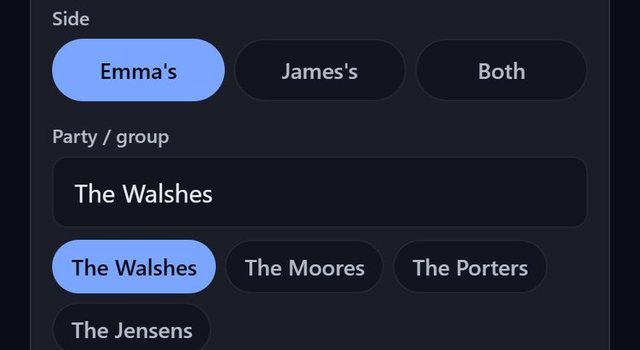
- Mark each guest's side. At a wedding, each guest's screen asks whose side they are from, using the couple's names from the event title. The guest report shows the split, so you know how many relatives each parents' table has to host. See sides.
- Build the room. In Table setup, the Banquet template creates round tables of 8 plus a head table of 6 across the front. Rounds can also seat 10. Count the tables in the first row and use the distance table above to pick the parents' tables. See room templates.
- Name the tables. Give each table a name such as "Emma's parents" and a group such as "Family", so the plan reads clearly for the venue.
- Draw the dance floor, bar and entrance. Tap Area and drop them on the plan. Keeping the parents' tables away from the bar and the DJ is then something you can see, not guess. See areas.
- Keep apart anyone who should be. From a guest's screen, list people they should not share a table with. A table with a conflict is flagged on the floor plan, and seating a group onto a table warns you first. See conflicts.
- Seat the grandparents. Tag anyone who needs an easy route as Accessible; Smart fill places them near the entrance and away from the dance floor, as long as you have drawn both areas and a suitable table is free.
The floor-plan PDF shows tables and areas for whoever sets up the room; exports are part of Pro or an event pass. SeatSpot is available on Google Play and the App Store. For the whole job in order, see our step-by-step wedding seating chart guide.
Questions people ask
Where do parents sit with a sweetheart table?
At the tables of honor closest to it. With a sweetheart table, nobody but the couple sits up front, so the parents' table or tables take the best positions in the first row.
Who else sits at the parents' table?
Usually grandparents, siblings who are not in the wedding party, and the officiant and their spouse if they are invited, according to Paperlust.
How big should the parents' table be?
As big as the people you want there. A round of 8 holds two parents, four grandparents and two more guests. If both families share a table, check whether a round of 10 is enough before adding the officiant. Our post on how many guests fit at a round table has the sizes.
Created by Mariusz Bednarczyk and fact-checked against the sources above. He reads each post after publication. How we make posts: About the blog.
Plan it next
Related guides
- Where do divorced parents sit at a wedding?
- Sweetheart table vs head table: the floor math
- Where do kids sit at a wedding?
Start here: How to make a wedding seating chart, step by step
More in Seating charts and etiquette