
What size should a seating chart sign be?
A seating chart sign for most weddings should be 24 by 36 inches. At up to about 100 guests that size keeps every name readable from a few steps back; past 150 guests, go bigger or split the list across two boards.
An 18 by 24 inch board works only for small parties of around 50 guests or fewer. Below is the arithmetic behind those numbers, so you can check your own guest count and board before you send the file to a print shop.
What size seating chart sign do most weddings use?
The guides we read name similar boards but differ on how many guests each one holds:
| Source | Board | Guests it suggests |
|---|---|---|
| Wild Bloom Design Studio | 24 × 36 in | Seating charts in general; it advises against going smaller |
| Wild Bloom Design Studio | 18 × 24 in | Signs under about 100 guests, seen up close |
| Made and True (acrylic) | 24 × 30 in | Up to 170 |
| Made and True (acrylic) | 24 × 36 in | 171 to 225 |
| Made and True (acrylic) | 24 × 47 in | 226 to 325 |
The second source makes custom acrylic charts, so its counts presumably reflect its own layouts. Wild Bloom adds a simple test: if guests first see the sign from more than 10 feet away, choose 24 by 36. Neither gives a number for how far away a name should read, which is the thing that actually decides the size. So we worked it out.
How big should the names be on a seating chart?
Sign makers use a rule of thumb: every inch of letter height reads from about 10 feet away. Banners.com, which prints signs, publishes that rule with a table running from half an inch at 5 feet to 20 inches at 200 feet. It assumes bold, high-contrast, sans-serif type in decent light, and says to take 25 to 30 percent off the distance for script or serif type, light colors or viewing at an angle.
A guest at a seating chart usually stands one or two steps away, so 3 to 4 feet is the useful target. By the 10-feet rule that means capital letters about 0.4 inches tall for bold sans-serif names, and nearly 0.6 inches for a script or serif face. For comparison, a capital letter in 12-point type on a letter page is roughly 0.12 inches tall, so a readable chart needs names three to five times the size of a printed document.
How many guests fit on a 24 x 36 seating chart?
To link board size to reading distance we estimated how much of the board each name takes:
- Each line: a name and table number, about 25 characters, as in "Margaret Ellison ...... 12".
- Width: an average character is about 0.7 times the height of a capital letter, so a line is about 17.5 letter-heights wide.
- Spacing: each line takes twice the letter height, to leave gaps between lines and columns.
- Margins: 2 inches around the edge and 5 more at the top for a heading.
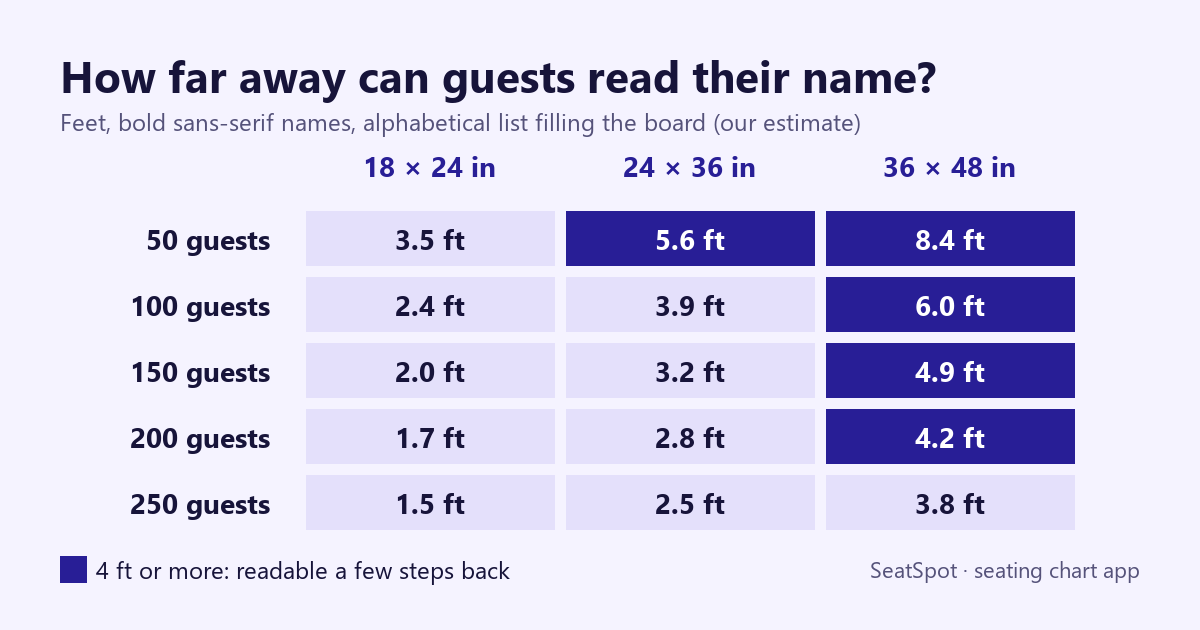
That gives each entry 35 times the letter height squared. Divide the usable area by the number of guests, take the square root, and you have the letter height that fills the board; multiply by 10 for the reading distance in feet.
| Guests | 18 × 24 in (ft) | 24 × 36 in (ft) | 36 × 48 in (ft) |
|---|---|---|---|
| 50 | 3.5 | 5.6 | 8.4 |
| 100 | 2.4 | 3.9 | 6.0 |
| 150 | 2.0 | 3.2 | 4.9 |
| 200 | 1.7 | 2.8 | 4.2 |
| 250 | 1.5 | 2.5 | 3.8 |
Read it as: at 100 guests on a 24 by 36 board, names are about 0.39 inches tall and readable from about 3.9 feet in bold sans-serif. In a script face, take off 30 percent, which leaves about 2.7 feet: guests have to walk right up to it.
Three things follow. A 24 by 36 board is comfortable up to about 100 guests and workable to 150. An 18 by 24 board reaches the 3 to 4 foot target only at about 50 guests. And at 200 guests only a 36 by 48 board stays at 4 feet; at 250 even that falls just short.
These are our estimates from a rule of thumb, not a standard. Heavier type, more contrast and less decoration all help; a busy background or a mirror board works against you.
When should you split the seating chart into two boards?
Split when one board would push the reading distance toward 3 feet. On a 24 by 36 board our numbers give 3.2 feet at 150 guests and drop under 3 feet at about 170.
Two boards of 24 by 36 for 200 guests puts 100 names on each, back to about 3.9 feet. They also spread the crowd, which matters as much as the type: Made and True suggests leaving open floor in front of the chart for six to eight people and keeping it away from the bar, so people waiting for a drink are not standing in the way of people looking for their table. Split by count, not at a fixed letter, and keep a family on one board so nobody has to check both.
If you list by table rather than alphabetically, the same space rule applies; table headings take a little room, so expect slightly smaller names. Our post on alphabetical or by-table seating charts covers which order guests scan faster.
Doing this in SeatSpot
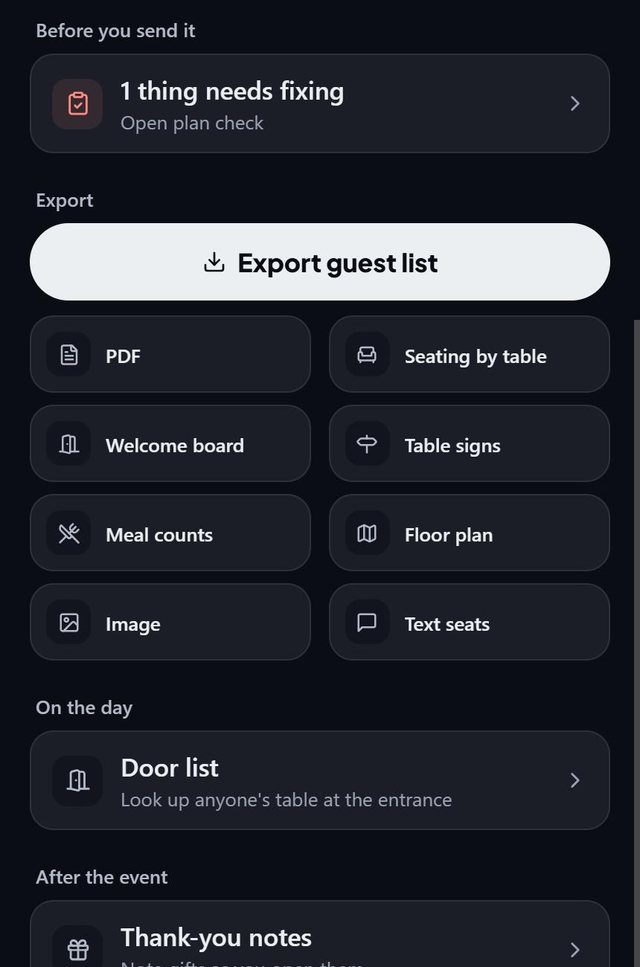
SeatSpot prints the board from your seating plan, so the names on the sign are the names in the plan.
- Finish the seating. Only guests with a seat appear on the board, so a sign printed from an unfinished plan is shorter than your guest list. Open plan check first to see who is still unseated.
- Pick the look. On the Cards tab, tap change design and choose a style: Modern, Classic, Minimal or Script, and one of six ink colors. The welcome board and table signs print in the same style and color as the cards. See card design.
- Export the board. Go to the Guests tab, open Guest report and tap Welcome board. Choose Letter pages for a home printer, with names in alphabetical order and the table beside each, or Poster 18 × 24 in or Poster 24 × 36 in for a print shop. The poster lists each table as a block with its guests underneath, under the event name and Please find your seat.
- Send the PDF as it is. The page is already the right size for the poster, so the shop does not need to scale it. See exports.
The poster comes in those two sizes and prints on one sheet, so a 36 by 48 board or a list split across two boards needs its own layout. The board leaves out RSVP answers, meal choices and placeholder marks on purpose, because it hangs in public. SeatSpot is available on Google Play and the App Store.
Questions people ask
How big should a wedding seating chart be?
24 by 36 inches for most weddings. It keeps names readable from about 4 feet at 100 guests. Go to 36 by 48 or two boards at around 170 guests and up.
What size seating chart for 100 guests?
24 by 36 inches. On our estimate names come out about 0.39 inches tall and readable from about 3.9 feet in bold sans-serif type. An 18 by 24 board is too small at this count.
Is 24 x 36 big enough for 150 guests?
Yes, but only just. On our estimate names come out about a third of an inch tall and readable from a little over 3 feet in bold type. Use a plain, heavy face, or split the list across two boards.
Is 18 x 24 or 24 x 36 better for a seating chart?
24 by 36 for almost every wedding. An 18 by 24 board keeps names readable from a few steps back only for about 50 guests or fewer, and only in bold type.
What size seating chart for 200 guests?
Either one 36 by 48 inch board, which keeps names readable from about 4 feet, or two 24 by 36 boards with 100 names each. Two boards also halve the crowd in front of each one.
What font is easiest to read on a seating chart?
A bold sans-serif. The sign rule we used assumes it, and it advises cutting the reading distance by 25 to 30 percent for script or serif type. Keep script for the heading if you love it.
Created by Mariusz Bednarczyk and fact-checked against the sources above. He reads each post after publication. How we make posts: About the blog.
Plan it next
Related guides
- Escort cards vs place cards: which do you need?
- How to print place cards at home
- How to make a wedding seating chart, step by step
Start here: How to make a wedding seating chart, step by step
More in Printing and place cards