
Escort cards vs place cards: which do you need?
Escort cards vs place cards comes down to one question: are you assigning tables or seats? An escort card waits near the entrance and tells a guest which table is theirs; a place card sits at the plate and marks the exact chair.
Most receptions need a way to assign tables, either escort cards or a seating chart sign. Place cards are the optional extra, and they earn their place when you serve a plated meal or want specific people side by side. Below is how to decide, what each card says, and how much printing each choice means for a 120-guest wedding.
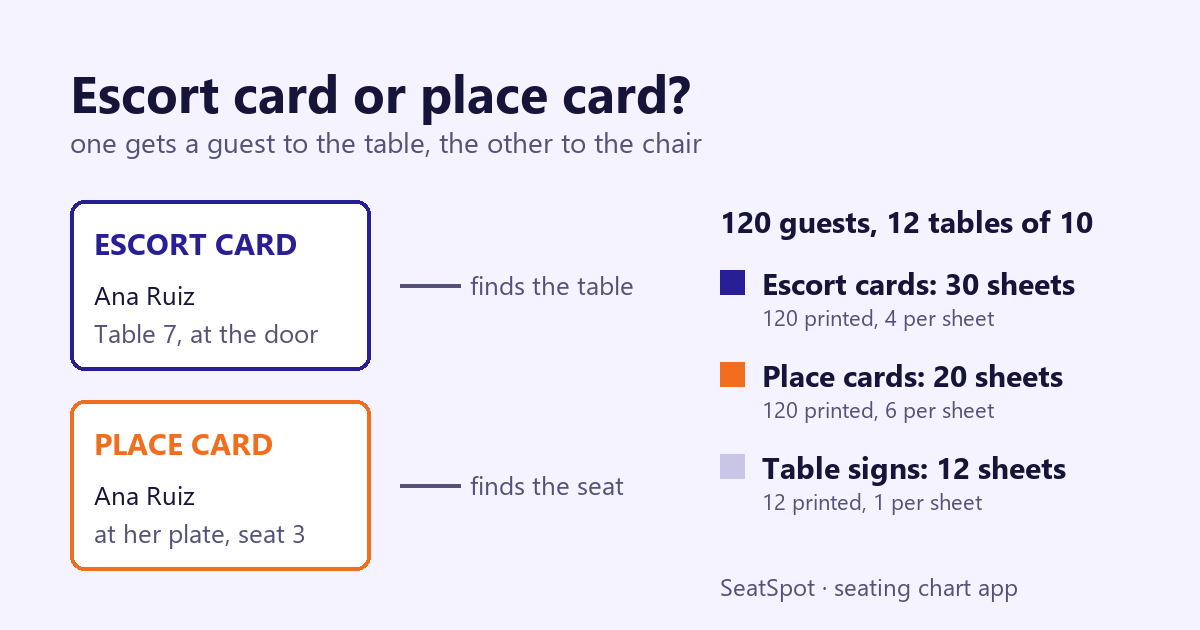
What is the difference between escort cards and place cards?
An escort card carries a guest's name and their table number or table name. It is displayed where people arrive, often on a table near the entrance or the cocktail area, and guests pick theirs up before walking in. Joy, WeddingWire and Paperlust all recommend setting them out in alphabetical order so the line at the entrance moves.
A place card carries the guest's name and stands at one place setting. Paperlust gives the usual size as about 3.5 by 2 inches or 4 by 2 inches, and WeddingWire describes it as roughly business-card size. It can also carry a small meal mark for the servers.
The two work as a relay: the escort card gets someone across the room, the place card settles them into a chair. A place card on its own does not help a guest who has no idea which of fifteen tables to look at, which is why WeddingWire says that if you use place cards you still need escort cards or a chart.
Do you need both escort cards and place cards?
It depends on how the meal is served and how many people are coming. Here is the decision, combining what Paperlust, Joy and WeddingWire advise:
| Your reception | Tables assigned with | Place cards? | Why |
|---|---|---|---|
| Buffet or stations, any size | Escort cards or a chart sign | No | Guests choose their own chair at their table |
| Plated dinner with chosen entrees | Escort cards or a chart sign | Yes | Servers need to know whose plate is the fish |
| Formal or black-tie dinner | Escort cards | Yes | Seats are part of the plan |
| About 80 guests or more, relaxed | Escort cards | Optional | Paperlust names this the most common escort-only case |
| Under about 40 to 50 guests | Place cards alone, or a chart sign | Optional | Paperlust says place cards alone can work at this size |
| Very small, about 20 to 30 people | Often nothing | Optional | WeddingWire's cut-off for skipping assigned tables |
| Casual backyard or park party | Nothing | No | Joy lists open seating as an option here |
Joy adds a practical warning about open seating: guests leave gaps between groups, so you may need more tables, and more linens, than the headcount suggests.
Plated dinners are where both cards pull their weight. Joy notes that when guests choose their entree in advance, the venue will likely require place cards showing each guest's entree, so the servers deliver the right plate without asking.
What goes on an escort card?
Keep it short: the guest's name and the table. Paperlust lists a meal mark as optional on the escort card too, but if the place card already carries it, there is no need to print it twice.
A few wording rules, from WeddingWire and Paperlust and our own printing:
- Match the invitations. WeddingWire suggests wording the cards the way you addressed the invites. A formal wedding can use a title such as Mr. or Ms. with the last name.
- Unnamed plus-ones. Paperlust suggests "Guest of" followed by the name of the guest who is bringing them. If you learn the plus-one's name before you print, use it.
- One card per couple works for escort cards, not place cards. WeddingWire points out that each person still needs their own place card at the table.
If you are torn between ordering the display alphabetically or by table, our post on alphabetical or by-table seating charts walks through both.
Can a seating chart replace escort cards?
Yes. A single sign listing every guest and their table does the same job as a box of escort cards, and Shutterfly says to pick one of the two, since using both is usually redundant. The trade-off it names: a sign gives you one display to manage, but when everyone arrives at once, people crowd around it. Separate cards spread the crowd out along a table.
Whichever you choose, every table needs a visible number or name; Joy makes the point that escort cards only work when guests can spot the table they point to. If you are still deciding how cards and signs fit into the whole job, our step-by-step wedding seating chart guide puts them in order.
How many sheets do escort and place cards take?
We worked this out for a plated wedding of 120 guests at 12 tables of 10, one card per guest, using the layouts SeatSpot prints: escort cards four to a sheet, place cards six to a sheet, and one sheet per table sign.
| Item | Printed | Per sheet | Sheets |
|---|---|---|---|
| Escort cards | 120 | 4 | 30 |
| Place cards | 120 | 6 | 20 |
| Table signs | 12 | 1 | 12 |
| Total | 62 |
Going escort-only for a buffet drops the place cards and leaves 42 sheets. Swapping the escort cards for a single chart sign leaves the table signs and one poster. Add spares to each card count before you buy paper; our guide to printing place cards at home has the spare-card numbers and the printer settings.
Paperlust suggests ordering printed cards about 4 to 6 weeks before the wedding, once the guest list and tables are final. If you print at home, you can wait until the seats are settled.
Doing this in SeatSpot
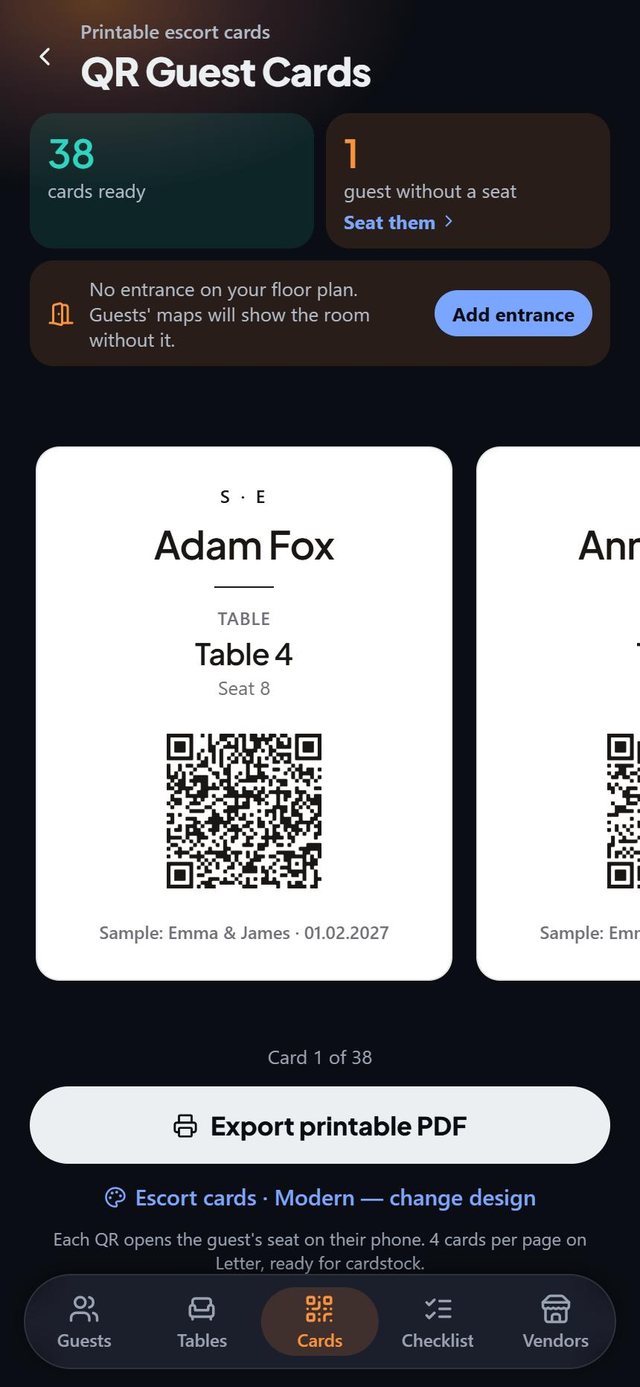
SeatSpot prints both kinds of card from the same seating plan, so a guest's table on the escort card and their name at the plate always agree.
- Seat everyone. A card exists only for a guest with a seat. The Cards tab shows how many cards are ready and how many attending guests still have no seat, with Seat them to jump to the Tables tab.
- Choose the format. Under the preview on the Cards tab, tap change design. Escort cards lie flat at the entrance with the guest's table and seat, four to a Letter page. Place cards fold in half and stand at the plate, six to a page, with the name on both halves. See escort cards and card design.
- Add the meal for plated dinners. Turn on Main course under the name to print each guest's main course on their place card.
- Decide on the QR code. Escort cards can carry a code that opens the guest's table and seat with a small map of the room. Leave it off if you prefer; the table and seat are always printed in ink.
- Prefer a sign? The Welcome board export prints every seated guest alphabetically with their table on Letter pages, or as an 18 by 24 or 24 by 36 inch poster with each table's guests listed under it. Table signs print one folded sheet per table, using the same table names as the cards.
Exports are part of Pro or an event pass. SeatSpot is available on Google Play and the App Store.
Questions people ask
Do kids need place cards?
A child with their own chair gets one, Paperlust says, while a child sharing an adult's seat does not. WeddingWire exempts babies and infants. Cards for a kids' table can use first names.
Should escort cards be in envelopes?
Not necessarily. Paperlust notes that envelopes are the traditional way, but many couples now skip them.
Where do escort cards go?
At the entrance to the reception or in the cocktail area, where guests pass before they sit down. WeddingWire suggests sharing a welcome table with the guest book and card box.
Can you use escort cards without place cards?
Yes. It is the usual setup for a buffet or a relaxed dinner: guests know their table and pick any chair at it.
Created by Mariusz Bednarczyk and fact-checked against the sources above. He reads each post after publication. How we make posts: About the blog.
Plan it next
Related guides
- How to print place cards at home
- What size should a seating chart sign be?
- How to give your caterer entree counts by table
Start here: How to make a wedding seating chart, step by step
More in Printing and place cards