
Alphabetical seating chart or by table? How to choose
List guests alphabetically by last name once you have about 80 guests or more, and save the by-table layout for small dinners of around 60 to 75. Guests know their own name, not their table number, so an alphabetical board lets them find it at a glance while a by-table board makes them read through other people's names first.
Should a wedding seating chart be alphabetical or by table?
For most weddings, alphabetical. The three guides we read agree on the reason. A wedding planner's blog puts it simply: the whole point of assigned seating is to remove guesswork, and a guest who does not know their table can only find it on a by-table board by scanning every name. At the entrance, that turns into a queue.
The guides draw the line at slightly different places:
- A stationery company recommends alphabetical by last name as the default from 80 guests, by table for 60 guests or fewer, and splitting the chart into two panels, A to M and N to Z, at 150 guests or more.
- A seating-sign template site calls by table a small-wedding format that works best at around 75 guests or fewer, and says to default to alphabetical above 100.
- The planner's blog goes further: alphabetical always, unless there are only two tables.
Between 60 and 80 guests the choice is yours. Go by table if guests arrive in families who will look for their group together, and alphabetical if most arrive as couples or alone.
How much slower is a by-table board?
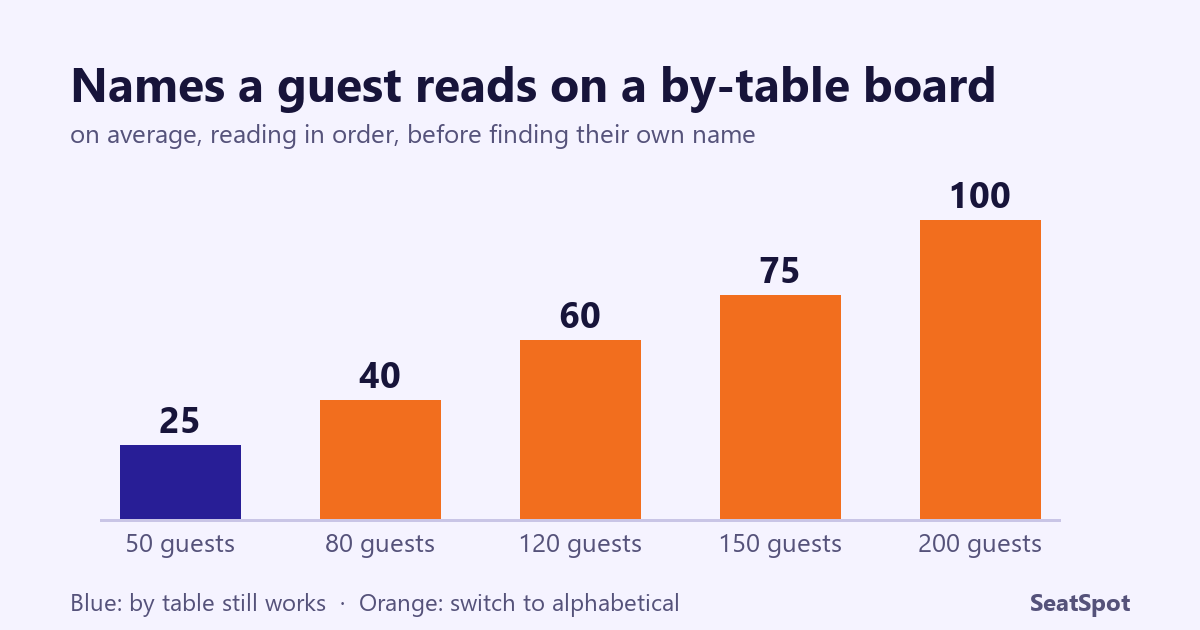
Here is our own rough model. On a by-table board, a guest who reads in order finds their name, on average, halfway through the list. On an alphabetical board they jump to their letter and read only the few names around it.
| Guests | Tables at 8 per table | Names read on a by-table board, average | Suggested format |
|---|---|---|---|
| 50 | 7 | 25 | By table works |
| 80 | 10 | 40 | Alphabetical |
| 120 | 15 | 60 | Alphabetical |
| 150 | 19 | 75 | Alphabetical, split A to M and N to Z |
| 200 | 25 | 100 | Alphabetical, split into two panels |
The table counts assume 8 guests at each 60-inch round, the comfortable number from our post on how many guests fit at a round table, rounded up. The scan figure is simply half the guest list. Real guests skim faster than that, but the ratio holds: double the guests and a by-table board takes twice as long to read, while an alphabetical one barely changes. The stationery guide also calls by table poorly suited to more than 20 tables, which you reach at about 160 guests at 8 per table.
When does a by-table chart still make sense?
By table is not wrong, just slower. It suits:
- Small weddings and family dinners, roughly 60 to 75 guests or fewer, where a guest can scan the whole board in seconds.
- Groups that arrive together, such as families, who look for one table between them.
- Named tables that tell a story, such as places the couple has lived, where the board itself is part of the decor.
- A narrow entrance, according to the template site, where a single grouped board fits better than a long list.
If you use named tables on any board, the template site suggests a small table number next to each table name so that guests with poor eyesight can still find their way. With names instead of numbers, the stationery guide treats alphabetical as nearly required and suggests pairing it with a room map.
How do you list couples, families and plus-ones?
The stationery guide's formatting rules are worth following whichever layout you choose:
- Pick one name format and keep it. First Last reads warmer; Last, First is quicker to scan in a long alphabetical list.
- Couples go on one line: "James and Sarah Mitchell", or "James Mitchell and Sarah Chen" when the surnames differ.
- Hyphenated surnames file under the first part, so Martinez-Webb goes under M, not W.
- Plus-ones get their real name when you know it. Otherwise write "Sarah Mitchell and Guest", never "+1" or "Plus One".
- Children can share their parents' line as "and Family", or sit on their own lines just below it.
- Match the place cards. The names and any courtesy titles on the board should be written the same way as on the cards at the table.
On an alphabetical board, put the table number to the right of each name, in a lighter or contrasting color, so the eye goes from name to number without effort.
How do you split a chart for 150 guests or more?
The stationery guide's answer is two panels, A to M and N to Z, set a little apart so guests do not crowd one sign. Give each panel a clear "A to M" or "N to Z" header so guests know which one to walk to.
Doing this in SeatSpot
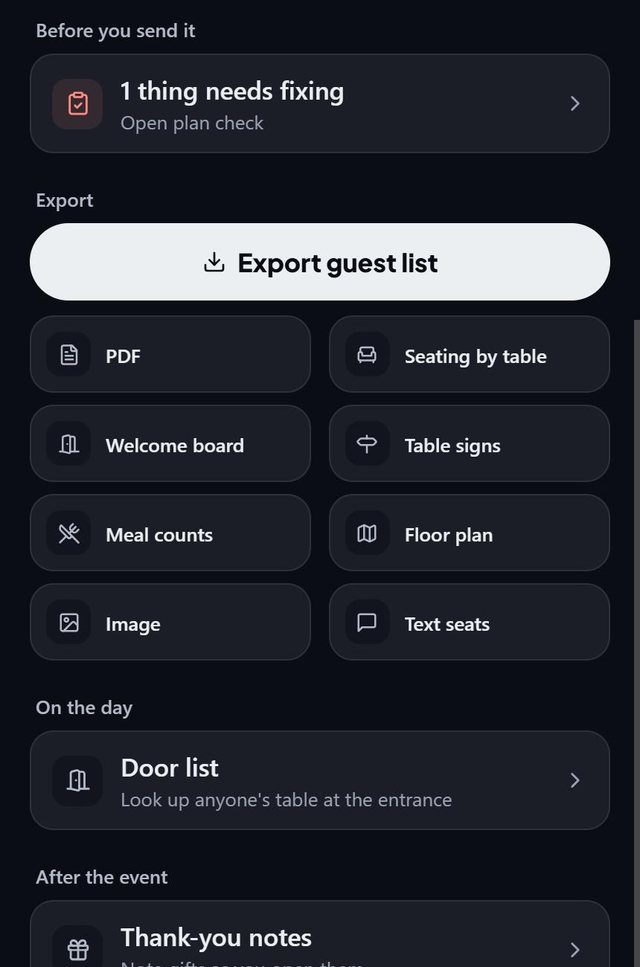
SeatSpot prints both layouts from the same seating plan, so you can choose at the end, not at the start.
- Seat your guests first. Only guests who have a seat appear on the welcome board, so check that everyone is placed before you print.
- Open Guest report → Export → Welcome board. Choose Letter pages for an alphabetical board: names in alphabetical order with the table beside each one, large type in two columns, printed at home.
- For a by-table poster, choose Poster 18 × 24 in or Poster 24 × 36 in instead. Each table is a block with its guests underneath in seat order, under the event name and Please find your seat. Send the PDF to a print shop as it is; the page is already the right size. See printing and exports.
- Check what the board leaves out. The welcome board shows no RSVP answers, meal choices or placeholder names, and seat numbers are left off on purpose, because a guest is looking for a table.
- Back it up at the door. The door list under Guest report → On the day lets whoever stands at the entrance type part of a first or last name and see the table and seat, with no connection needed.
SeatSpot is available on Google Play and the App Store.
Questions people ask
Should a wedding seating chart be alphabetical?
Yes, for most weddings over about 80 guests. Guests know their own name, not their table, so an alphabetical list is faster to read.
Is a seating chart by table number ever better?
For small weddings of roughly 60 to 75 guests or fewer, for family groups who arrive together, or when named tables are part of the decor.
How do you list a plus-one whose name you do not know?
Write the guest's name followed by "and Guest", for example "Sarah Mitchell and Guest". Ask the guest for the name before you print if you can.
Do you sort an alphabetical seating chart by first or last name?
By last name is the usual choice. Whatever you pick, use the same format for every guest and on the place cards.
Created by Mariusz Bednarczyk and fact-checked against the sources above. He reads each post after publication. How we make posts: About the blog.
Plan it next
Related guides
- How to choose a seating chart app: an honest guide
- How to make a wedding seating chart, step by step
- Wedding singles table: should you have one?
Start here: How to make a wedding seating chart, step by step
More in Seating charts and etiquette