
How to give your caterer entree counts by table
For a plated dinner with a choice of entree, give the caterer two lists: the total of each dish for the kitchen, and a count of each dish at every table for the servers. Then mark each guest's choice on the card at their seat, so the plate reaches the right person and not just the right table.
Does the caterer need meal choices by table?
For a plated meal with more than one entree, usually yes. The kitchen cooks to the totals, but the servers carry trays to one table at a time, and they need to know how many of each plate to load. The University of Richmond's catering team, for example, asks couples who offer several entrees for a seating chart with each guest's table assignment, and wants the final count and table needs ten business days before the wedding.
Collecting choices ahead is the common advice. WeddingWire reported that 73 percent of the caterers it surveyed recommend it, and quoted one caterer who put the cost of letting guests order on the night at about 30 percent more, because the kitchen has to make extra of everything. Buffet, family-style and stations avoid the question entirely. Our guide to when the caterer needs a final headcount covers the deadlines; this post is about the shape of the lists you send.
What does an entree count by table look like?
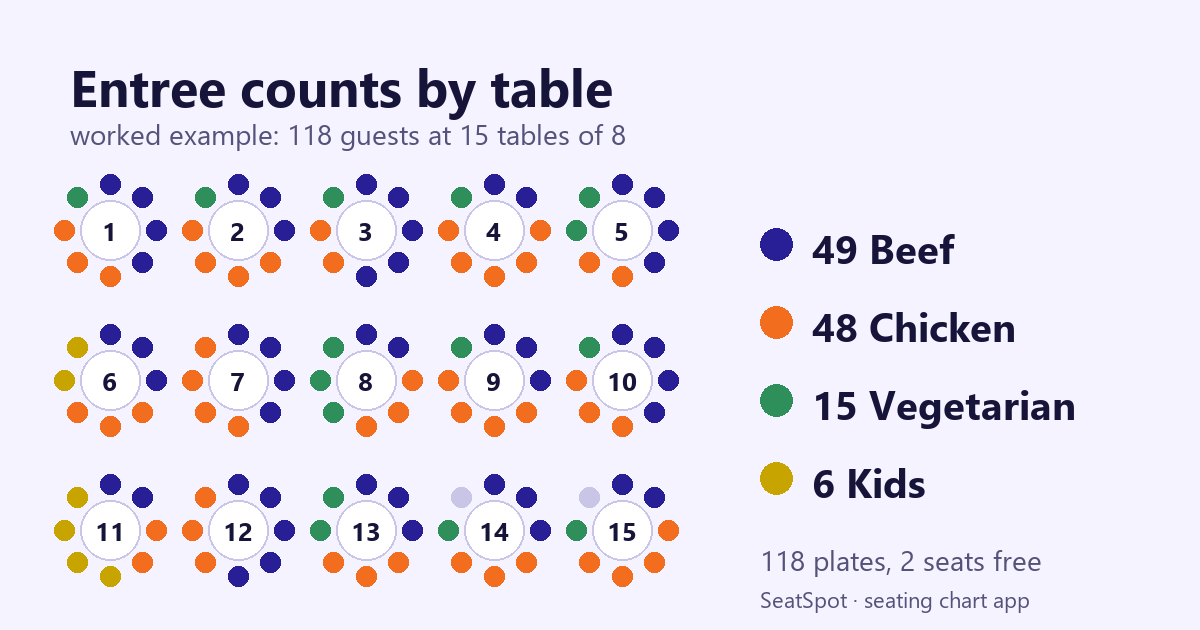
Here is our worked example: 118 attending guests at 15 round tables of 8, with three adult entrees and a kids' meal. These are invented numbers to show the format, not a typical split. First, the list for the kitchen:
| Dish | Plates |
|---|---|
| Beef | 49 |
| Chicken | 48 |
| Vegetarian | 15 |
| Kids' meal | 6 |
| Total | 118 |
Then the list for the servers, one row per table:
| Table | Beef | Chicken | Vegetarian | Kids | Guests |
|---|---|---|---|---|---|
| 1 | 4 | 3 | 1 | 0 | 8 |
| 2 | 3 | 4 | 1 | 0 | 8 |
| 3 | 5 | 2 | 1 | 0 | 8 |
| 4 | 2 | 5 | 1 | 0 | 8 |
| 5 | 4 | 2 | 2 | 0 | 8 |
| 6 | 3 | 3 | 0 | 2 | 8 |
| 7 | 4 | 4 | 0 | 0 | 8 |
| 8 | 2 | 3 | 3 | 0 | 8 |
| 9 | 3 | 4 | 1 | 0 | 8 |
| 10 | 4 | 3 | 1 | 0 | 8 |
| 11 | 2 | 2 | 0 | 4 | 8 |
| 12 | 5 | 3 | 0 | 0 | 8 |
| 13 | 3 | 3 | 2 | 0 | 8 |
| 14 | 3 | 3 | 1 | 0 | 7 |
| 15 | 2 | 4 | 1 | 0 | 7 |
| Total | 49 | 48 | 15 | 6 | 118 |
Two checks catch most mistakes before the caterer sees them. Every row must add up to the number of guests at that table, and every column must add up to the kitchen total. If the columns add up to 118 but the kitchen list says 120, two people have a meal and no seat, or a seat and no meal.
The table also shows why the totals alone are not enough. Table 11 has four kids' meals, and table 7 has no vegetarian plate. A server who only knows "15 vegetarian somewhere in the room" has to ask at every table.
How do you mark meal choice on place cards?
The counts get the right plates to the table; a mark on the card gets each plate to the right chair. Paperlust's place card guide calls the place card the standard way for caterers to match plates to guests, and suggests keeping the mark readable for staff but discreet for guests. Its options:
- Shapes: for example a circle for poultry, a square for beef, a triangle for fish, a leaf for vegetarian and a star for kids.
- A coloured dot: a sticker on the back or the bottom edge of the card.
- A short code: two or three letters printed small in a lower corner.
Whichever you choose, agree it with the caterer before you print, and give the head server the key in writing. WeddingWire suggests asking guests to initial their choice on the RSVP card, and labelling the kids' option "Children's meal" rather than writing "child".
Meal indicator on escort cards or place cards?
Put the mark where the guest ends up sitting. With assigned seats and place cards at each setting, the place card carries it. If you only assign tables, guests carry their escort card to whichever chair they pick, so the mark has to be on the escort card and the guest should leave it at the plate. Our post on displaying the seating chart alphabetically or by table covers how guests find the table in the first place.
What if a guest forgets their meal choice?
It happens, which is why the mark is on the card and not only in the guest's memory. If someone has no choice on file at all, chase them before the deadline rather than on the night. Our guide to following up on RSVPs that never came back has scripts for that. Ask the caterer whether they keep a few spare plates of each entree, and how many, so you know what is possible when a choice was lost.
Doing this in SeatSpot
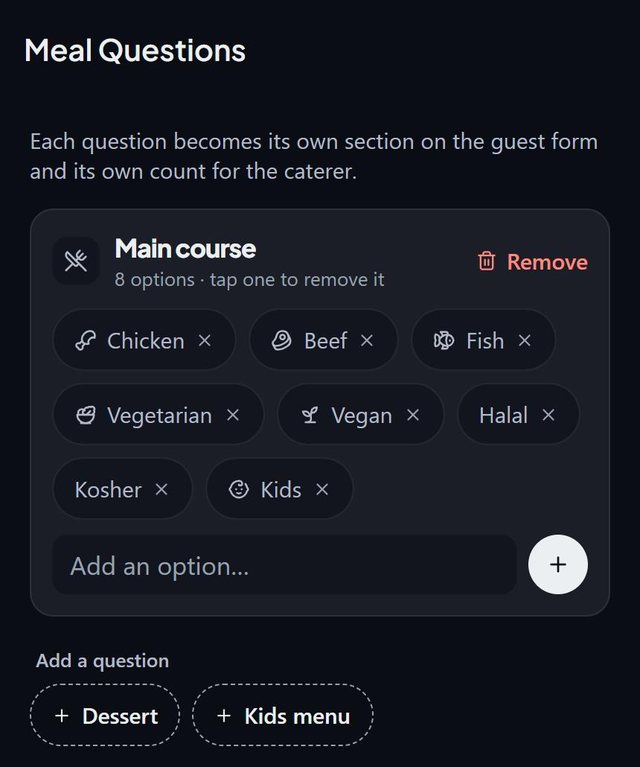
SeatSpot keeps the meal answer on each guest, so the totals, the by-table sheet and the cards all come from the same record.
- Turn on the question. From the guest report, open Edit questions and switch on Main course. Edit the answers to match your caterer's menu. Add Kids menu if they offer one. See meals.
- Enter the replies. Each guest's screen offers the question. When a stack of RSVP cards comes back, turn on selection on the guest list, tick the people, then Meal and the option. It only fills blanks, so an answer someone already gave is never overwritten. See bulk edit.
- Send the kitchen its totals. The Meal counts export totals each answer and counts only guests marked Attending. Anyone attending without an answer is listed as not chosen, so the gap is visible. Dietary needs follow table by table, with allergies in bold. See meal counts.
- Send the servers the tables. The Seating by table export lists each table in seat order with each guest's meal choice beside their name.
- Print the mark. In Card Design, choose place cards and switch on Main course under the name, which prints each guest's main course in small capitals. If you would rather use stickers or shapes, print the cards without it and use the Seating by table sheet as your key. See escort and place cards.
The exports are part of SeatSpot Pro. SeatSpot is available on Google Play and the App Store.
Questions people ask
When are entree counts due?
It depends on the venue, and the entree count is often due with the final headcount or before it. The University of Richmond, for example, wants the menu two months ahead and the final count ten business days before. Check your contract.
Do I need assigned seats for a plated dinner with choices?
Not always. Assigned tables are enough if the meal mark travels with the guest on the escort card. Assigned seats make service faster, because the plate can be placed by seat.
Should the meal be written in words on the card?
Words are clearest for servers. Some couples find them too visible to other guests and use a shape, colour or short code instead. Either works if the caterer has the key.
Do kids' meals count in the entree total?
List them as their own line. They are a different plate for the kitchen, and servers need to know which tables get them.
Created by Mariusz Bednarczyk and fact-checked against the sources above. He reads each post after publication. How we make posts: About the blog.
Plan it next
Related guides
- When does the caterer need a final headcount?
- Escort cards vs place cards: which do you need?
- How to print place cards at home
Start here: How to make a wedding seating chart, step by step
More in Catering and meals